SUMMARY
Explore teaching general music through a culturally responsive lens. Part 4: Opening Routines provides an opportunity to acknowledge each student and can be expanded to incorporate partner work and composition.
by Manju Durairaj




Explore teaching general music through a culturally responsive lens. Part 4: Opening Routines provides an opportunity to acknowledge each student and can be expanded to incorporate partner work and composition.
by Manju Durairaj
The ideas, notes, and materials are the intellectual property of Manju Durairaj. Please use and adapt them for use in your music room. However, you do not have permission to share without the express permission of the author.
Opening routines may vary depending on the time of year, mode of teaching, or the curricular context. These routines may include a greeting song, a chant, or body percussion; whatever you choose to use, it is important to acknowledge each student.
Jyoti Dey is a call and response song that I initially created to sing with students during Diwali or Holi designed to be a song to give light. However, the song is simple enough that I altered the text to create a greeting song.

I make a point to acknowledge each of my students, so with my youngest students; I might alter the text to sing hello to each child without the response. However, with my older student’s I might change the activity into a tag game. I sing hello to a student, and they would respond by singing hello back to me, then sing hello to another student, until we have acknowledged all of the students in the class.
This model can work while teaching remotely by having each student unmute themselves when it is their turn to sing their response. If singing is not allowed, we can always speak the song as a chant or use a recording instead.


I usually have an underlying body percussion, found sound, or rhythmic pattern for students to play on any surface. In this instance, I would change the text to the song. Instead of singing hello to acknowledge a student, I would play a four-beat pattern for the person I tag to imitate. (Click image to enlarge.)
In addition to imitating body percussion patterns, students can also create body percussion patterns of their own. I initially have students use one or two levels of body percussion when creating their pattern. As students become more proficient, they can choose from all four levels of body percussion; snap, clap, pat, and stamp. (Click image to enlarge.)

Students can create body percussion patterns synchronously, asynchronously, or in person. I like giving students a template to guide their learning because students love working with pairs or small groups, and the template helps keep them on task.
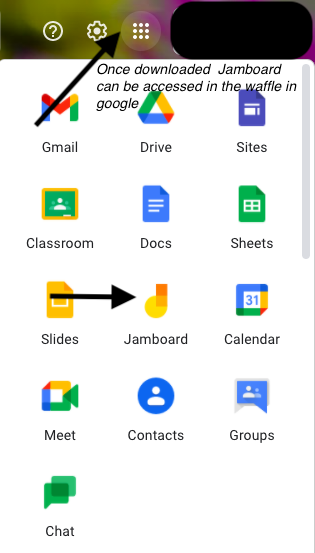
I created a template in Jamboard for students to work with while in breakout rooms. Jamboard is a google app used to create interactive worksheets that students can use online in both synchronous and asynchronous learning environments. Once downloaded, you will have access to Jamboard in your Waffle of Apps in Google.
With the Jamboard, I can use it as an interactive whiteboard, giving students access to write and annotate in real-time with me. Jamboard allows me to write rhythmic dictation, call on a student and have them interact with me using this technology. I am also able to upload images as I did with the body percussion template.
Then I can create multiple copies, assign each group a page, and they will be able to interact with the template by clicking and dragging the body percussion icons onto the staff in their breakout rooms. This activity allows students to share the body percussion ostinato they created in their small groups with the whole class.
You can recreate this activity in Google Slides if that is your preferred technology. You can assign students into groups to work. Additionally, you can add an interactive component using Pear Deck if you prefer individual responses from your students. Finally, you could use Seesaw if you wanted students to record and submit a video of their work.
I have included links to my Jamboard and Google Slides if you want to experiment on your own. In this lesson, we looked at creating an interactive experience with our students using Jamboard, Google Slides, and Pear Deck.
Jamboard
https://jamboard.google.com/d/1XG71O77Xaoaw7n1tQbb64ax_J77p9DFkGkFK3TrBjPU/edit?usp=sharing
Google Slides
https://docs.google.com/presentation/d/1gBHxTOY8aYBVpChNlJatvSbRML2_4ocylY411hf_siM/edit?usp=sharing
Pear Deck
https://docs.google.com/presentation/d/1cfjZTe-ePB5MnWkwN4Q8qBFX5Hsp-BQVqsFldq-WGOw/edit?usp=sharing
Creating connections with your students and fostering relationships among students is difficult online, but as I have demonstrated, not impossible. In Part 5: Teaching Singing the Virtual Way, I will share how I approach singing.
Part 1: Detangling the Terminology
Part 2: Creating a Learning Partnership
Part 3: Technology and the Music Room
Part 4: Opening Routines – Creating Connections
Part 5: Teaching Singing the Virtual Way
Part 6: Chanting and Hand-Clapping Games from a Distance
Part 7: Integrating Dance in an Online Setting
Part 8: Playing & Performing With Online Musical Tools
Part 9: Video – Sing, Say, Dance and Play in a Responsive Way

Contributor
Manju Durairaj was born and raised in India, studied in Pune, India, and was involved in graduate research projects on comparative pedagogical practices of Indian (Carnatic) and Western Music at Middlesex University, London, UK. She graduated with her second…
Discover more from Manju Facebook
 Twitter
 Pinterest
 LinkedIn
 Email
Email Print
Print