SUMMARY
Examine the process of teaching improvisation in this series of articles by Jeremy Howard. Part 3: Learn about pre-literacy improvisation in musical warm-ups.
by Jeremy Howard





SUMMARY
Examine the process of teaching improvisation in this series of articles by Jeremy Howard. Part 3: Learn about pre-literacy improvisation in musical warm-ups.
by Jeremy Howard
Students must begin improvising from an early age to gain experience with the components of improvisation, as discussed in the last article. Now, we will explore other aspects of musical improvisation, such as movement, vocal exploration, the four voices, and comparatives.
These are all considered pre-literacy improvisations that allow the child to create freely in a playful manner and free up their first instrument: the body (including their voice and ear)! Students are most engaged in learning when they are playing, and their whole body is active.
Mr. Slidey is a hit! Add finger puppet eyes near the mouthpiece of a slide whistle, and voila – kids love him. I recently had a kindergarten student touring Monticello with his family. The gift shop sold slide whistles, and that was what he wanted to take home because “Mr. Howard has one!”. He and his brother came home with slide whistles, so I supplied the googly eyes.
I introduce students to Mr. Slidey and inform students that he speaks another language and has two favorite words they’ll need to translate. I then play a descending sound, and the class resounds in a unanimous “Down!” while mimicking the descending pitch.
Then, Mr. Slidey makes an ascending sound, and the students respond, “Up!” (admit it – you just read that in your head with the correct pitch exploration. Way to go, you audiator, you!).
Additionally, Mr. Slidey’s tongue, the slide, reflects the sound’s motion, so there is a visual cue for the students. Mr. Slidey visits every class period and does various sequenced activities (see picture below) that become the pre-curser student improvisation.
One of my favorite activities is to bring in Mr. Slidey when he has a cold. He’s lost his voice! So, I have Mr. Slidey’s tongue go in and out without blowing any air into the mouthpiece. Students are then audiating and recalling Mr. Slidey’s sounds. Get creative with wiggles, starts and stops, and long and short notes.
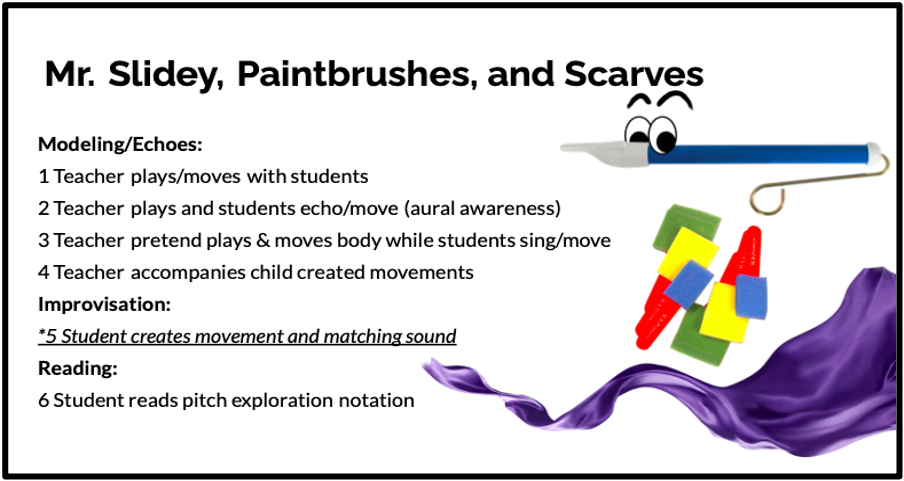
Mr. Slidey is a vocal model. The students are engaged in understanding Mr. Slidey’s language and extract meaning from the sounds he’s making (receptive language). Once they have made sense of the sounds through kinesthetic activities such as body movements and echoes, they have a sound bank to pull from and recreate musical speech.
Recreate the same types of experience using paintbrushes. I recommend the paintbrushes with foam at the end of the handle as opposed to the bristles. They are cheap, come in various sizes, the handles are large enough for small hands, and they are multiple colors.
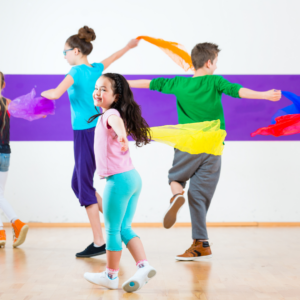
Have students paint in the air. Let them paint the room the color of their choice. One student may paint it “blue” while creating their own vocal exploration to matches their movement. Another may paint “red” but while exploring their voice differently. Maybe they will paint polka-dots, long stripes vertical or horizontal, zig-zags. Be creative!
Finally, break out those scarves and streamers. I find my students do best with vocal exploration when given a concrete task: translate Mr. Slidey, paint the room, etc. This bit of creativity adds the “protection layer,” allowing students to freely explore the possibilities of sound-making without placing the focus on their voice.
The Four Voices
When preparing to teach the Four Voices, teachers must remember that we ask students to identify the voice they hear and produce the voice independently. Remember, we must also teach them how to use their voice in a variety of ways.
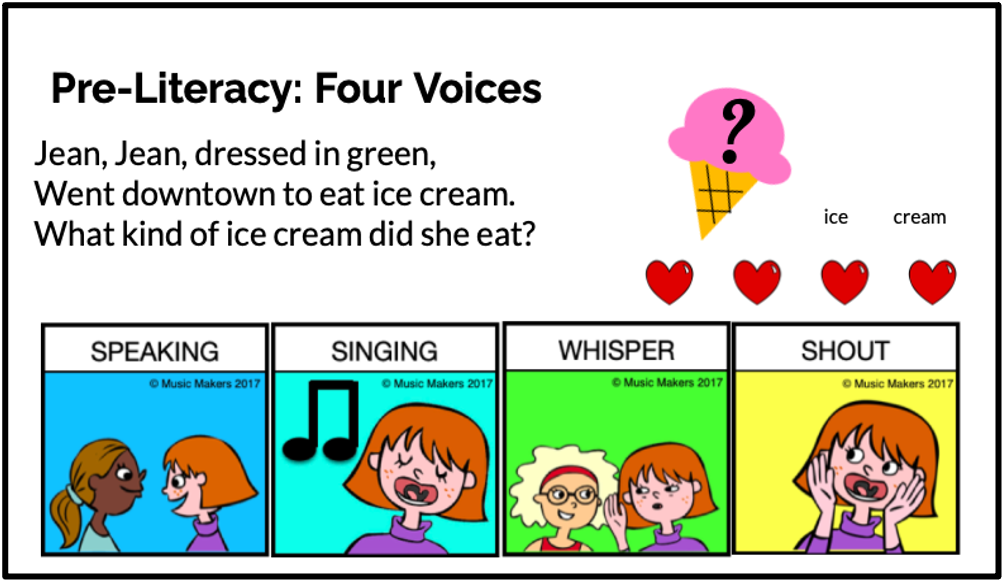
Students gain vocal flexibility using the four voices and learn how to switch on the fly! Notice the graphic below. The words of the rhyme, “Jean, Jean,” are visible, as well as the choices (the four voices) and framework (ice cream flavors) for their improvisation. Achieve the same results with other rhymes as well. Get creative!
If only mind control worked… sigh! Well, at least we can pretend (and the kids believe this one)! Students start by telling the story of “Wee Willie Winkie.” Each time the teacher rings the bell, they must change the comparative and continue the story. Don’t take this too quickly at the beginning; maybe only one change. Then, try changing every phrase. And if they keep up with that, the sky’s the limit!
In Part 1: Learning the Language of Music we compared the acquisition of music and language. Part 2: The Process of Improvisation we used the Three-Step Process (Timing, Choice, Framework) for improvising words only. Part 3: Warming Up with Pre-Literacy we used vocal exploration, the four voices, and comparatives, we have expanded our students’ abilities to improvise. Part 4: Pre-Literacy Improvisation in Songs and Stories of this series will examine and apply the processes previously explored and develop our students’ knowledge using singing games and folk songs.
Part 1: Learning the Language of Music
Part 2: The Process of Improvisation
Part 3: Warming Up with Pre-Literacy Improvisation
Part 4: Pre-Literacy Improvisation in Songs and Stories
Part 5: Pre-Rhythm and Pre-Melodic Improvisation
Part 6: Question and Answer Improvisation
Part 7: Rhythm and Melody Improvisation Games
Part 8: Putting the Puzzle Together

Contributor
Jeremy Howard received a BME in vocal music education and an MM with an emphasis in the Kodály philosophy from Morehead State University and is a certified Kodály educator. Additionally, he studied at the Kodály Institute in Kecskemet, Hungary. Mr. Howard serves as the 3 Year-Old through 8th Grade…
Discover more from Jeremy Facebook
 Twitter
 Pinterest
 LinkedIn
 Email
Email Print
Print