SUMMARY
Examine the process of teaching improvisation in this series of articles by Jeremy Howard. Part 1: Learn how language acquisition and the steps of improvisation are similar.
by Jeremy Howard





Examine the process of teaching improvisation in this series of articles by Jeremy Howard. Part 1: Learn how language acquisition and the steps of improvisation are similar.
by Jeremy Howard
Take a moment to think about “improvisation.” Imagine a jazz band saxophonist standing up to deliver her speech, followed by each of the other instruments delivering their filibuster in turn. Or, picture the lead guitarist from a classic rock band speaking his soul for the next six minutes. If not one of those, think of a classical performer waiting to show off their virtuosic abilities to talk in the composer’s dialect.
The common thread in each example is a professional musician with advanced “music as a language” skills. Notice that we think of improvisation as something only attained by musicians of the highest quality – musical prodigies. With this thinking, improvisation is a skill that becomes something extra beyond an average musician’s capabilities, and most likely, developed naturally.
We also might have a fear-inducing view of improvisation if we are the musicians asked to improvise. In part, this fear is due to the lack of musical training in improvising during our musical studies. Musicians view improvisation as a practice reserved for specific genres of music or instruments.
When it comes to improvisation with students, you may be picturing prepared pentatonic pitched percussion (say that five times fast)! Let’s explore the necessary skills, the process, and other activities for developing this elusive skill.
When compared to language acquisition, improvisation functions in the same manner as independent thought and free speech – an ever-expanding skill that begins in the early stages of musical development. Once we teach our students new vocabulary (rhythms or pitches), do we allow them time to become fluent with the language – to not only read and write but spontaneously speak their musical thoughts into creation?
The process of learning to improvise is just as important as the final product. During the process, students are developing a musical syntax – an oral (kinesthetic) working knowledge of rhythmic and melodic concepts of their own creation.
In the Kodály Concept, the music learning sequence parallels learning a language, sound before symbol.
Using the Kodály Concept sequence as a guide, improvisation develops during the “speaking and singing” step. Children should be playing with sounds. Giving children numerous opportunities to ”speak music” develops their understanding of the musical syntax. Luckily for us, most music teachers provide plenty of experiences using the first step, modeling, through echoes. Now we must make a conscious effort to build our students’ other skills, beginning with memorization.
Comparing spoken language to musical language (see table below), the process begins with aural awareness—dividing speech into two categories: receptive and expressive language.
According to TheEdadvocate.org, receptive language is the ability to understand words. We define expressive language as the ability to request objects, make choices, and ask questions. When using receptive language, students are extracting data and meaning from the sounds they hear. Receptive language’s musical counterpart, vocal performance, the process of echoing and decoding provide a foundation for understanding through musical syntax.
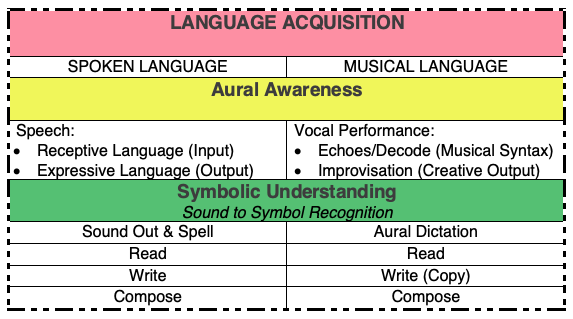
In short, students must hear us sing, not just for vocal technique, but also the workings of steady beat, rhythm, meter, pitch, intervals, phrases, etc. These echoed phrases become the students’ “words,” which are memorized and repeated, eventually leading students to break down the smaller parts (motifs) and reuse them in new ways, which is improvisation!
We have compared the acquisition of music and language. In Part 2: The Process of Improvisation will define the components of improvisation and apply these principles while working with a familiar folk song.
Part 1: Learning the Language of Music
Part 2: The Process of Improvisation
Part 3: Warming Up with Pre-Literacy Improvisation
Part 4: Pre-Literacy Improvisation in Songs and Stories
Part 5: Pre-Rhythm and Pre-Melodic Improvisation
Part 6: Question and Answer Improvisation
Part 7: Rhythm and Melody Improvisation Games
Part 8: Putting the Puzzle Together

Contributor
Jeremy Howard received a BME in vocal music education and an MM with an emphasis in the Kodály philosophy from Morehead State University and is a certified Kodály educator. Additionally, he studied at the Kodály Institute in Kecskemet, Hungary. Mr. Howard serves as the 3 Year-Old through 8th Grade…
Discover more from JeremyHello (not ? Log out)
 Facebook
 Twitter
 Pinterest
 LinkedIn
 Email
Email Print
Print
Kathleen Staten
February 3, 2022
My favorite part: The process of learning to improvise is just as important as the final product.