This article explores the benefits of play-along videos for students who struggle with traditional notation, highlights different play-along video methodologies, and emphasizes the importance of teacher guidance in maximizing their educational impact.
by Tyler Swick
Teacher Toolbox
A Case for Iconic Notation
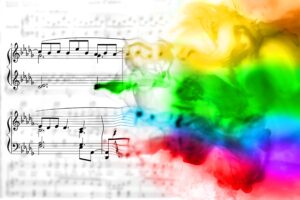
Discover a new way to teach your students to read music! Standard notation does not always click for students. Introducing iconic notation, which can be color-coded to show note duration and pitch relation, might solve this dilemma.
YouTube play-along videos have gained significant traction in elementary music classrooms since the rise and fall of online learning. These videos, typically featuring a mix of visual and audio prompts, have become a valuable tool for engaging young musicians in learning music outside the traditional methods. While there are many factors that contribute to their success, this article profiles the students that are benefiting the most, explores the types of non-traditional notation that have been particularly successful for students who do not read treble clef, and discusses the importance of teacher-guided instruction alongside these videos.
Benefits of Play-Along Videos for Diverse Learning Styles
Play-along videos offer a unique blend of entertainment and education, which is essential for keeping elementary-aged children engaged. These videos allow students to actively participate in music-making without requiring a long learning curve or prior knowledge of notation systems. The ability to play along with familiar songs, rhythms, or melodies, often paired with animated visuals or instrument demonstrations, makes the process of learning fun and accessible. This instant gratification of producing music helps boost students’ confidence and enthusiasm for learning.
Not all students learn in the same way, and play-along videos cater to a wide range of learning styles. Kinesthetic learners who thrive through hands-on activities can play along with the music, while auditory learners benefit from the sounds they hear. Visual learners can follow along with the on-screen notes or cues. This multi-sensory approach ensures that each student can connect with the content in a way that suits their individual learning preferences. Beyond games about learning to read music, traditional notation is a visual learners paradise but leaves auditory and kinesthetic learners needing more.
Challenges of Learning Traditional Notation
Traditional music notation, treble and bass clef, can be challenging for elementary-aged students, especially those who are just beginning their musical journey. My personal experience with the treble clef is that I left a school that never acknowledged instruments or notation and joined a school that had been teaching notation since the primary grades.
My first music class at my new school was a mixture of excitement and terror as the music teacher called out xylophones by name. The room was practically an F.A.O. Schwartz of instruments that I just wanted to get my hands on. “Tyler, go to the alto xylophone…” I froze because I didn’t know what an alto or a xylophone were. “Tyler…” My ignorance was perceived as defiance. But it was cooler to look mean than to look stupid, so I did an arrogant strut to the biggest xylophone, hoping that was the one I would get to play. “No, that’s a bass, Tyler, go to an alto xylophone.” After an eternity, an empathetic student pointed to an alto xylophone. The teacher gestured toward a large treble clef on the white board with enough dots to make me think of a Jackson Pollock before music. It was probably 6 notes, but I was overwhelmed.
Imagining the Future: Navigating Musical Possibilities
Have you ever wanted to see what your students will become? I constantly wish there was a floating menu above every student’s head that told me what their job would be, how much money they would make, if they’ll go to prison, or their greatest life achievement. At that moment, my first day in the new school’s music class, I was ready to cry myself out of the room, but my overhead banner would say “Future Music Teacher.” I faked playing the notes on the board and eventually mimicked the student next to me. I memorized the pattern as a defense mechanism because I didn’t want to risk losing the right to play the xylophone. I wouldn’t understand the treble clef until the 8th grade, but somehow, managed to make plenty of music before then. My professional work has aimed to help students make music first and figure out notation later.
Two Approaches to Play-Along Videos: Visual Cueing and Pulse-Based Learning
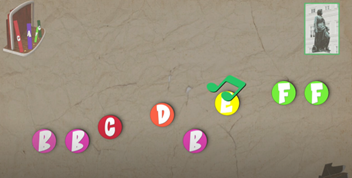
The most popular types of play-along videos boil down to two methodologies. Those that present all of the information with a bouncing dot emphasizing where the performer should look, and those that only present the information needed to play your next note. In this Mr. Henry’s Music World video, all of the notes in the phrase are visible and the green eighth notes travel across the screen, indicating when it is time to play. It moves at varying speeds to match the music needs. Students are able to anticipate their strike and develop an understanding of a larger musical picture.
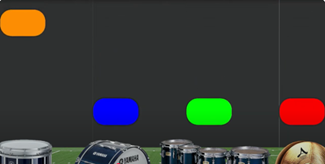
In this video from Swick’s Classroom, students have less time to anticipate the beat but are able to time their strike accurately because of the uniform distance from the top of the screen to the bottom. Though they are not presented with measures and phrases, they can visually see the pulse of the music falling down. Neither video denotes rhythm in a traditional way yet both can create a successful performance to a classroom of young musicians.
Enhancing Learning Through Color Coding
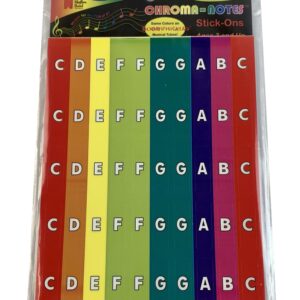
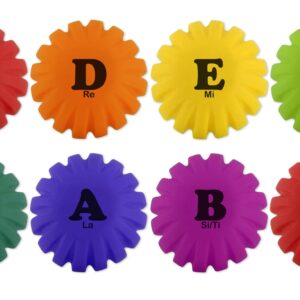
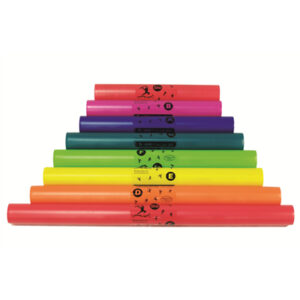
Both types of videos lean heavily on conveying information through color. Though the students in my classroom may not know the names of the 3 drums and cymbals in the drumline video, I can assign colors. Same for the color-coded pitched instruments. Red is becoming universal with C and I think that’s to all of our benefit. Boomwhackers, Thumpers, handbells, Mel-O-Dee Balls, and even barred instruments are accessible through this color-coded system. A sticker placed on xylophone bars or recorders can let students know which target to aim for when playing along to these videos.
The Power of Visual Learning
As a creator of some of these videos, I’ve received comments from schools that specialize in teaching deaf and hard of hearing students that play-along videos have been the tool they’ve needed all along. Conveying all of the information visually eliminated the need for an arduous explanation of musical elements.
A high school in the United States reached out, sharing that a student with autism has gone from hating music for being overstimulating to fully participating in group play-alongs. They shared that the student requested a Beach Boys song everyday but they couldn’t find any Beach Boys play-alongs. Absolutely in love with this story, I made him his very own Surfin’ USA video and dedicated it to his high school. I received a video a week later of the student gleefully jamming along. I cried profusely.
Interactions like these were a catalyst to create more content and spread the word that music teachers are reaching students in new ways. I encouraged you to find what engages your students the most and if something doesn’t exist, and you have the power to make it, share it with the world.
References
Mr. Henry’s Music World. (n.d.). Boomwhackers Play Along: Classical Composer Ultimate Mix!YouTube
Swick’s Classroom. (n.d.). Elementary Rhythm Warm-Up | 4 Part Percussion.YouTube
Tyler Swick is an elementary music teacher in Las Vegas, NV where he runs an award-winning general music program and manages the YouTube channel, “Swick’s Classroom.” Swick is an inaugural Yamaha 40 Under 40 Music Educator class member, the…




 Facebook
 Twitter
 Pinterest
 LinkedIn
 Email
Email Print
Print