Explain why the left hand must be positioned on top when playing the recorder by linking it to the woodwind family. This discussion should cover how the history and design of instruments like the flute and clarinet influence hand position. By understanding these connections, students will find it easier to transition to playing band instruments.
Relating Recorder to the Rest of the Woodwind Family
As a clarinet player, I love playing any and all woodwind instruments. I often get the chance to play in a community band, or demonstrate my instruments for my class, and one of the greatest things about the woodwind family is how interconnected they are.
With a big push in incorporating core subjects into special classes, some teachers think “how can I incorporate STEM into music class? What about history and social studies?”
Enter: the recorder.
A Brief History of The Woodwinds
As our music history knowledge remembers, the recorder evolved from early woodwind instruments used during the Middle Ages and Renaissance in Europe. This instrument was fairly small, and easy to travel with, which made it a favorite among street musicians. This instrument was “all the rage” because it could be used in the church or in secular music, and groups would get together and jam, creating consorts. Players enjoyed this instrument because there was music written for a basic beginner, all the way up to a very advanced musician. The recorder (like the flute, which we will talk about later), emulated the sound of the voice, which was a big deal in music during this time, so it was pleasant to listen to in any setting. This was seen as a valid and “real” instrument during this time, different from the “squeaky thing my kid came home with” we sometimes hear now.
During the Baroque era, the recorder was at the height of its popularity. The major composers like Bach and Vivaldi wrote a lot of fancy music specifically for the recorder. With more technical music, instrument makers spent time improving the instrument so players would have a better way of tuning the instrument while playing. This made the instrument sound better, thus making more people want to listen to it and play.
After the Baroque era, the recorder was gradually replaced by the transverse flute, which had technically been around before the recorder (prehistoric times) but the instrument had made many adjustments that made it more applicable to the music being played at the time. Flutes were able to play with an extended range, due to added keys.
Quickly after came the early oboe (evolved from the shawm), and the bassoon. The oboe and bassoon were different because they had a double reed, which created a new sound that composers loved. The double reed stood out from the string section and other woodwinds and had a very distinctive sound. I like to refer to the double reeds as character instruments, or instruments that create a vivid picture in your mind—you can almost imagine what a character playing that instrument would look like based on the unique sound it produces.
The clarinet came a little after that, evolving from the chalumeau instrument, which is why there is a chalumeau register on the clarinet (the low, dark chocolate sound in the bottom register). Fast forward about a hundred years, and we have the invention of the saxophone (Adolphe Sax named it after himself). This is when orchestras were giving way to the new concert and marching band craze, and bands needed a louder instrument that could be like a woodwind instrument AND a brass instrument. Sadly, the saxophone wasn’t allowed to play with the orchestra formally, which is why you don’t see saxophone on your “Instruments of the Orchestra” posters.
How does this relate to the recorder?
In my classroom, I like to use woodwind instruments to demonstrate a lot of musical concepts. From recorders, to slide whistles, to flutes, the sounds are very versatile and diverse, and make it easy to produce sound. That being said, my students are familiar with these instruments from pre-K and throughout their primary years until they learn recorder formally in third grade. After many years of using woodwind instruments throughout the progression of the curriculum, it has helped me answer one of elementary music’s biggest questions:
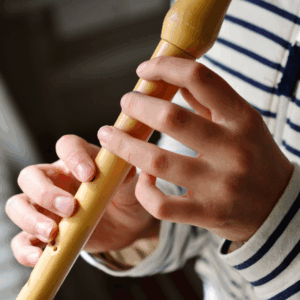
“Why does the left hand have to be on top?”
To that question, I can give several responses, all of which relate to science, history, and music! Check out my responses in relation to each woodwind instrument.
Recorders:
“My fingers don’t reach if my right hand is on top!”
As a clarinet player, of course it feels weird to put my right hand on top, but it is also physically harder to manipulate my hands in this way.
I use the other instruments in the consort to explain SATB voices, and how longer instruments make lower sounds, etc.
The highest “baby” of the recorder family, the Garklein, is so small that the holes are curved to accommodate your right hand on the bottom.
The bass recorder has keys (similar to clarinet) that allow for venting and register changes.
Flute:
“The fingerings on the main register of the flute are the same as the recorder. The left hand is the hand that would be on top if you held it like a recorder!”
Students that have older siblings in band may be able to relate to them playing the flute. Since both instruments are in the key of C, explain that now, the siblings can play music together.
Basic fingerings, D, E, G, A, B, C’ are similar to the modern flute
This can also be applied to any indigenous wooden flutes and fifes you may have as demonstration instruments.
Clarinet:
“The higher register on the clarinet (the clarion register) has the same fingerings as the recorder! My left hand is on top because I need to be able to place my fingers in these certain positions to push these particular buttons and keys.”
Students with siblings in band would not be able to play the exact same music with a clarinet (in key of Bb) and a recorder (key of C)
Basic fingerings, D, E, G, A, B are similar to the clarinet in the clarion register. Notice that F is not on this list. F does its own thing on the recorder.
Oboe and Bassoon:
Honestly, I do not use these instruments when teaching the recorder. I relate the history and acoustics of the instruments to the recorder, but you will not see me walking around a class of thirty recorder students with a bassoon. The oboe would be able to play with the recorder, as they are both C instruments. Bassoon and Oboe both are designed for left hand on top playing, especially with the crazy thumb mechanism on the bassoon.
Saxophone:
The saxophone will be similar to the clarinet, except that it is in Eb (Alto and Baritone) or Bb (Soprano or Tenor) Fingers will be similar to the flute or clarion register of the clarinet. Even though keys are different, I transpose when playing with the kids because I can use it as a hook for reluctant players. Add a saxophone, and that song is instantly cooler.
Other woodwinds that could be used:
Slide whistle- Relate the stopper and slide on the slide whistle to the size of the recorder. Explain how, by covering the holes, you are making that instrument shorter or longer, which affects the pitch.
Kazoo- Explain how a kazoo works like a double reed instrument and there is a vibration that occurs when you blow into it. Sound does not happen without vibration.
Songflute, Fluteophone, or Tin/Penny Whistle– all similar to the recorder, just in different shapes and sizes. This would make a great comparison activity.
Conclusion
In conclusion, I like making connections such as the ideas outlined above because it helps me understand the concept more. This is my idea of multiple means of representation because one explanation may work for one child, but not another student. Sometimes, the kids make these connections on their own, but many times you can guide them to discover how everything is connected. Music is woven throughout all subjects, it’s not just a room you go to for forty-five minutes a day!
Kelsey Helton is an elementary music teacher in the Dallas-Fort Worth area. Kelsey currently teaches PreK-5th grade music in Grapevine-Colleyville ISD and directs an after-school choir, the Singing Stars, and directs the all-school musical. She is also a musician at…




 Facebook
 Twitter
 Pinterest
 LinkedIn
 Email
Email Print
Print