This article offers practical, experience-based techniques including IEP-aligned goal setting, instrument modifications, and targeted support systems to help music educators meaningfully include students with disabilities in the music classroom.
The music classroom today has new challenges that many educators have never faced before. More and more students with disabilities are being integrated into the classroom with various support measures. Unfortunately, many of these students are kept on the outskirts of the classroom and are given distractions to “make it through the class.” This leaves a void in the education that our students were intended to interact with in our classrooms. In talking with other music educators, I have found that the desire to properly include these students is present, but there is a lack of direction on how to properly include them. Here are some of the strategies I have used in my teaching both in the classroom and in one-on-one lessons.
Creating Goals Using the IEP Goal Setting Method
An IEP (Individual Education Plan) is an education plan designed to help students with disabilities learn in measurable ways that coincide with their disability. In this plan, students, parents, teachers, therapists, and other stakeholders (like specialty teachers) contribute observations and develop specific goals that are measurable and frequently monitored to help the student make as much progress throughout the year as they possibly can. This model has been effective in academic and behavioral goals but has not been fully utilized for music education.
We can use the IEP goal setting method to create measurable goals that we can monitor in our music classroom. To do this would require coordination with the special education team that directly works with the individual students, talking with the student’s parents or guardians, talking with the student’s homeroom or classroom teacher (depending on grade level), and talking directly with the student. This collaboration will reveal the groundwork of what the student is able to do and frame the goal, or goals, each student can work towards.
An example of this would be the goal “I can keep a beat.” This is a fantastic first step in music education because it doesn’t require fully developed motor or cognitive skills, just the ability to move. Within this goal, micro-goals could be set and monitored. Here is an example of how to track this goal through micro-goals:
Music Goal: I Can Keep a Beat
I can move my body in response to music: The student will respond to music stimuli by moving their body to the music. This can be swaying, tapping, clapping, stomping, or any consistent movement to music stimuli.
I can pat my legs: The student will pat their legs 16 times in a row.
I can pat my legs to my own beat: The student will pat their legs in consistent intervals 16 times. The tempo will not be set by the instructor; however, the taps must be in a consistent tempo of the student’s choice.
I can pat my legs on the beat to a common song: Using a song the student has become familiar with, the student will tap the beat 16 times or for 16 counts. Songs like “ABC’s,” “The Itsy Bitsy Spider,” or other simple songs would be appropriate.
I can pat my legs on the beat to a common song when it is sped up or slowed down: The student will be able to tap the beat on their legs 16 times or for 16 counts as the song is sped up or slowed down.
This is just an example of how to use the IEP goal setting method. In the above example, I am using a simple way for the student to learn the music concept of beat at their own pace with measurable goals. This will also allow the student to interact with music concepts as their classmates learn the same idea using rhythm sticks or body percussion drills. It is a matter of setting a goal that modifies the lesson to an achievable and meaningful interaction for the student with disabilities. Using the IEP goal setting method has been one of the most effective adaptive music strategies thus far in my experience and has kept my students engaged in music class.
Modifying Instrumental Exercises
Students always respond positively to playing instruments in the music classroom. Classroom instruments are a great tool to teach music concepts, but they can also highlight the limitations of some of our students with disabilities. Many times, this is when we see the student disengage or begin to show undesirable behavioral reactions that can be linked with their needs. As a result, paraprofessionals may remove students and bring them to the back of the classroom or take them out of class altogether. To avoid this, we need to be prepared with modifications for the needs of these students.
Changing the instrument itself to accommodate the student’s disability is a great way to modify an instrumental exercise. Instruments requiring a specific type of grasp can be challenging for many students with disabilities. Simply changing the instrument being used can be the solution. The triangle is an example of a classroom instrument that really requires a specific grip. A student with disabilities might struggle to hold the triangle up by the string between two fingers and hold the metallic rod to strike the instrument with two fingers. The other obstacle present in the triangle is its size. Students struggling with a pincer grip tend to use more of a rake grasp, bending from the center of the hand. The triangle is just too small for the rake grasp. This can cause frustration and even disappointment for many students with disabilities related to motor function. To modify this, I bring out a resonance bell. This is an instrument that is a one note xylophone that the student does not need to physically hold. The mallet with a resonance bell is a long stick with a rubber head. This allows the student to use the rake grip and have control over the mallet.
A second change may also be needed related to rhythmic cognition. Students may not be able to process complex rhythms. In my experience, students with disabilities tend to struggle when a rhythm includes notes subdivided beyond an eighth note, or rhythms that include syncopation. As educators, we will need to put on our arranger hat and simplify the exercise for the student. Instead of triplet passages, simplify to a regular quarter note. Turn sixteenth-note passages into eighth-note passages. Skip syncopated notes and start on a note that lines up with a strong beat. These small modifications make the instrumental exercise accessible and performable for students with disabilities.
A third option involves modifying the instruments themselves to accommodate students’ motor skills. Sometimes adding a strap, thickening a handle with foam or tape, or reinforcing a drum head can make instruments better suited to individual needs. These are small changes that make a large impact.
Consider Appropriate Support Systems
Similar to what we would see in physical and occupational therapy, students with disabilities may need additional support when interacting in adaptive music class. This may be a physical support, a visual reminder, or an auditory reinforcement. All of which are easily implemented.
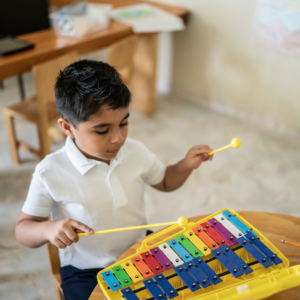
Physical support includes any kind of assistance that involves touching the student. The most common support used for music is called hand-over-hand support. An example would be helping a student play the xylophone: the student grasps the mallet to the best of their ability while the teacher holds the student’s same hand and guides them to the notes they need to hit. This is the most common physical support in an adaptive music classroom.
A visual reminder is exactly what it sounds like, a visual cue to aid students in reaching a desired outcome. An example could be a written-out rhythm with symbols to guide a student through a drumming drill. The extra symbols remind the student of a specific striking style or how the rhythm sounds. I have personally used this support with several of my snare drum players who had cognitive disabilities, with high success.
An auditory reinforcement is any sound used to help the student reach a desired outcome. This method is used frequently in general music classes, but in an adaptive music class it may need to be used more consistently. For example, when teaching a simple melody to sing, you may need to keep phrases slow and repeat them frequently to help students echo back the phrase.
Anticipated Outcomes of Adaptive Music Strategies
In the classroom, we like to think about the anticipated outcomes of teaching strategies and curriculum. We also use this approach to adaptive music strategies. Thinking about which students this would affect and how is the key to understanding what we may see in our students. In my experience, we can anticipate greater engagement in the music classroom among our students with disabilities. Students who normally would be given distractions to curb undesirable behavior will no longer need the distractions because they can successfully participate in class. Students will also be able to build on their skills more successfully and progress through music concepts more quickly. This could potentially allow students to perform music with their peers as well.
A music tutor can also anticipate positive outcomes from implementing adaptive music strategies. Students with disabilities will be able to gain more abilities on their instruments, progress through music concepts faster, and become more confident in their musicianship. Another possible outcome is growth in non-musical skills such as fine motor development.
Conclusion
Adaptive music strategies are a key to engaging students with disabilities in the music classroom. Developing a plan and implementing it through modifications suited to students’ needs can lead to anticipated outcomes that will have a positive effect. Modifications can be simple and, when used with the correct supports, can engage students who are typically left to the side. Adaptive music includes all students in a more effective and fulfilling music class.
References
Tarbet, B. (2025). Music without barriers: A guide for inclusive teaching. That Music Teacher. https://www.thatmusicteacher.com/disabilities
Tarbet, B. (2022, May 4). What is universal design for learning? (Season 3, Episode 73) [Podcast episode]. That Music Teacher. https://www.thatmusicteacher.com/podcasts/that-music-podcast-a-podcast-for-elementary-music-teachers/episodes/2147733385
William Parker is an educator and aspiring curriculum writer based in Seymour, Connecticut. He works as a music teacher in a Pre-k through 5th grade Elementary School in Waterbury Connecticut where he teaches band, choir, and general music. William…




 Facebook
 Twitter
 Pinterest
 LinkedIn
 Email
Email Print
Print