Summary
A practical guide to using Rhythmnische Übung etudes as rhythmic affirmations that boost student confidence, reinforce classroom values, and support musical learning through body percussion.
by Zachary Edwards






A practical guide to using Rhythmnische Übung etudes as rhythmic affirmations that boost student confidence, reinforce classroom values, and support musical learning through body percussion.
by Zachary Edwards

Students explore positive self-talk through rhythmic body percussion, adapting Keetman’s Rhythmnische Übung etudes. This lesson blends literature, reflection,
and performance, progressing from simple affirmations to ensemble work, while strengthening musical skills and self-confidence.
by Zachary Edwards
For someone first exploring the Rhythmnische Übung (RU), figuring out how to use it may feel like an enigma. However, the beauty of a book full of rhythmic body percussion etudes without words is that you can adapt them however you like—such as to create body percussion affirmations.
The most important part of an affirmation is the text. The words convey the message you want your students to internalize. Equally important is setting the text to a rhythm that aligns with natural speech prosody. Take the word “banana” for example—where does the stress fall? Since the stress is on the second syllable, the word has a natural anacrusis.
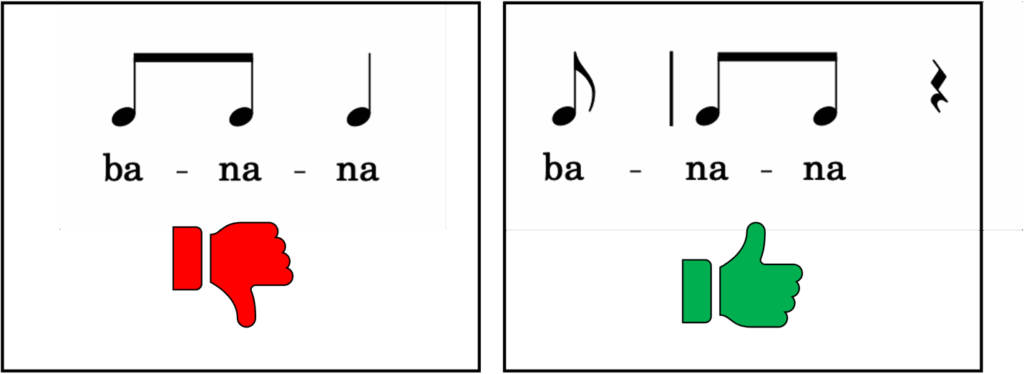
Think about the message you want to communicate—what specific words or phrases do you want to include? As you flip through the RU, look for etudes with rhythms that complement your chosen words. Don’t be afraid to adapt the rhythm to fit the text (or vice versa). You can even use an etude as inspiration for composing your own. This isn’t Beethoven’s Ninth Symphony—no one will be upset if you modify it to suit your needs and your students’ needs. You don’t even have to use the whole piece! Just because an etude is 32-beats long does not mean you can’t use just the first half (or even less).
One of the most effective ways to implement affirmations is as a class warmup. Starting every class with student affirmations can reinforce school or classroom values and sets a positive tone for a joyful music lesson.
You can also consider extending the activity to cover even more objectives:
The possibilities are endless!
For an example on how to implement this idea in a lesson, see our downloadable lesson, RU Affirmations.
Keetman, G. (1970). Rhythmnische Übung. Schott Music.

Contributor
Zachary B. Edwards is currently pursuing a Doctor of Musical Arts in music education at the University of Houston. His current roles include graduate teaching assistant and instructor in music education at the University of Houston, as well as…
Discover more from Zachary Facebook
 Twitter
 Pinterest
 LinkedIn
 Email
Email Print
Print