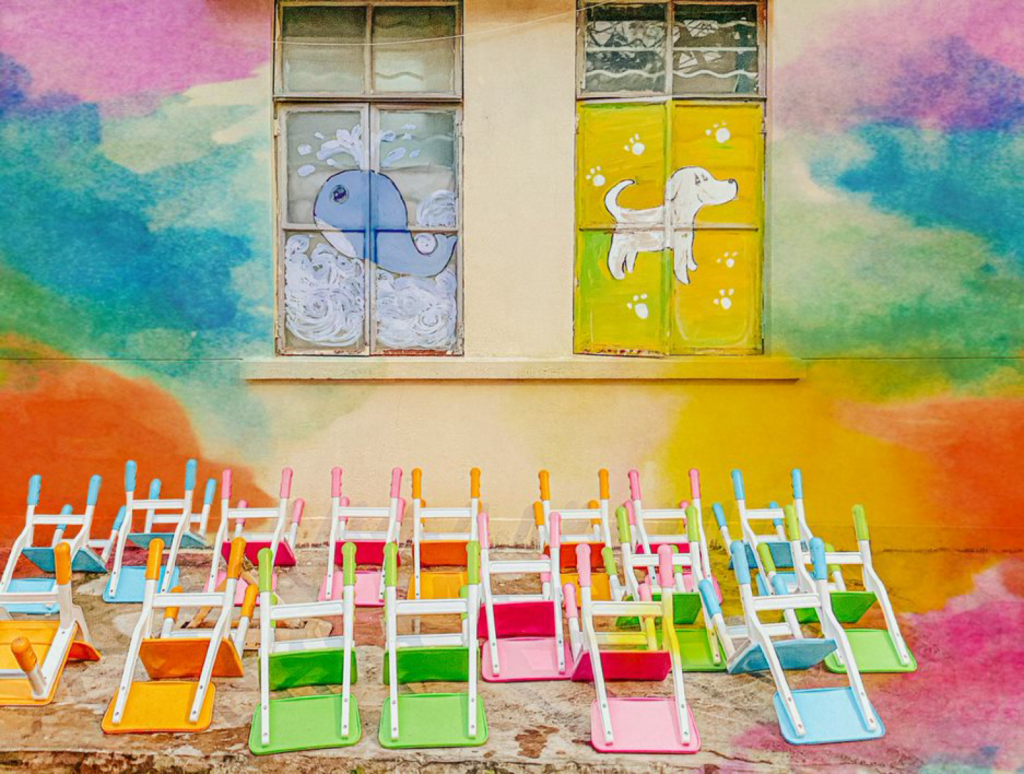
Why should play be the basis for student learning? How can teachers support playful experiences that honor student choice and voice? Answers to these and other questions help to distinguish between beneficial play-based experiences and those that are more restrictive.
Passing by a kindergarten classroom, I see a child quietly exploring with watercolors and a group excitedly building a block tower structure. I hear a pair of students discussing their restaurant menu in the kitchen and feel the buzz of students building a robot from loose parts. The possibilities to explore and create through play are endless, and the creative energy is contagious.
What makes the world of kindergarten so magical?
Friedrich Froebel, the inventor of kindergarten, recognized that young children construct meaning and purpose through playful experiences. At a time when most schools focused on students memorizing facts and discussion was not welcomed, learning through play was considered a radical idea.
Froebel knew that this type of approach would not be beneficial for five-year-olds who needed the chance to explore the world around them (Resnick, 2017). Even today, Froebel’s influence is visible in kindergarten classrooms. Teachers believe that childhood is valid in itself and should not solely exist to prepare for adulthood. When children can create and share their learning, we honor who they are and value their input.
Let’s discuss play…
Stuart Brown, the founder of the National Institute of Play, says, “the most significant aspect of play is that it allows us to express our joy and connect most deeply with the best in ourselves, and in others” (2009, p. 218).
Think about a favorite playful moment. What were you doing? What brought you the most joy? Who were you with? Our memories inform our values and beliefs. We can appreciate how play can vary from person to person and look different across cultures and contexts.
Let’s consider the difference between play and playfulness. Play describes a behavior, like children playing tag or hide and go seek. It is something children do. However, playfulness is a mindset or an attitude.
Jed Dearybury and Julie Jones, authors of The Playful Classroom, tell us that playfulness is a work in progress, and the more we let ourselves play, the more playful we become. Teachers are also encouraged to provide opportunities that invite playfulness into the classroom (2020).
Play-based learning in a music class may look different from a traditional kindergarten homeroom due to materials and experiences, but maintaining a playful spirit is what truly matters.
Playground versus Playpen
Several years ago, I felt something was missing from my kindergarten music lessons. On the surface, the lessons checked off all the specific knowledge and skill areas.
Vocal exploration, check.
Echo singing, check.
Steady beat, check.
Movement exploration, check.
I created active music-making experiences where students happily participated. I tossed in a sprinkle of “fun” by using pipe cleaners to explore pitch, made up new rhymes to songs, improvised dances, and composed rhythm patterns using picture icons. The content was not lacking; this was about the process.
A Playful Perspective
I read Lifelong Kindergarten by Mitchel Resnick, in which he says that at times it feels like kindergarten is becoming like the rest of school, with a push for more testing and data collection, leaving less time for play.
However, it should be the opposite, “the rest of school (indeed, the rest of life) should become more like kindergarten,” where play helps us engage in the creative process and develop as creative thinkers. As teachers, we must remember that not all types of play lead to learning and try to recognize the types that do (2017, p. 10).
Resnick highlights a metaphor by Marina Bers, who explains the difference between playpens and playgrounds. Each idea supports a fundamentally different type of play and learning. A playpen is a restrictive environment with limited opportunities for the child to move and explore. In contrast, a playground provides more significant opportunities for children to explore, collaborate, and express themselves.
This metaphor transformed and helped me reimagine how to plan for playful and explorative experiences in kindergarten music. While teachers may feel pressure to “fill up” a lesson to keep kindergarteners busy (more songs, more books, more movement, more instruments), I wondered if children actually need the opposite.
What if we allowed them space and time to discuss and try creative ideas with partners? Or invited them to explore unmetered sounds and all the ways their body can move? What if we purposefully engaged their senses and integrated other art forms? These are the questions I asked myself. What questions do you have?
Since becoming intentional about play, I discovered the following experiences have inspired my students and me, and perhaps they will do the same for you and your students. In the end, it is about exploring our own playful spirits and trusting that our playfulness will not encourage chaos but an unfolding of true creative potential. Will we feel vulnerable? Yes. Will it be messy? Yes. Will it be worth it? Absolutely.
Dearbury, J. & Jones, J. (2020). The playful classroom: The power of play for all ages. Hoboken, NJ: Jossey-Bass.
Goodkin, D. (2010). The ABC’s of education: A primer for schools to come. San Francisco, CA: Pentatonic Press.
Brown, S. & Vaughan, C. (2009). Play: How it shapes the brain, opens the imagination, and invigorates the soul. New York: Avery.
Resnick, M. (2017). Lifelong kindergarten: Cultivating creativity through projects, passion, peers, and play. Cambridge, MA: The MIT Press.
TEDx. (2017, December 1). Kindergarten for our whole lives|Mitchel Resnick [Video]. YouTube. https://www.youtube.com/watch?v=IfvgVpQI56I
TEDx. (2015, January 21). Young programmers – think playgrounds, not playpens|Marina Bers [Video]. YouTube. https://www.youtube.com/watch?v=jOQ-9S3lOnM
Tina Arenas teaches early childhood music and movement at the American School of Dubai. Prior to teaching abroad, she taught elementary general music in Texas. Tina received her Master of Music Education from the University of St. Thomas and…





 Facebook
 Twitter
 Pinterest
 LinkedIn
 Email
Email Print
Print