SUMMARY
Why should play be the basis for student learning? How can teachers support playful experiences that honor student choice and voice? Discover play-based examples that will change the way you teach music.
by Tina Arenas





Why should play be the basis for student learning? How can teachers support playful experiences that honor student choice and voice? Discover play-based examples that will change the way you teach music.
by Tina Arenas
In the last article, Playground v. Playpen: Approaching Kindergarten Music, I presented research and rationale to reimagine kindergarten music. Here are some ideas on how I reimagined Kindergarten general music.
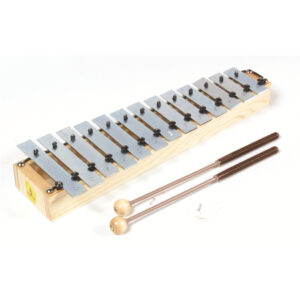
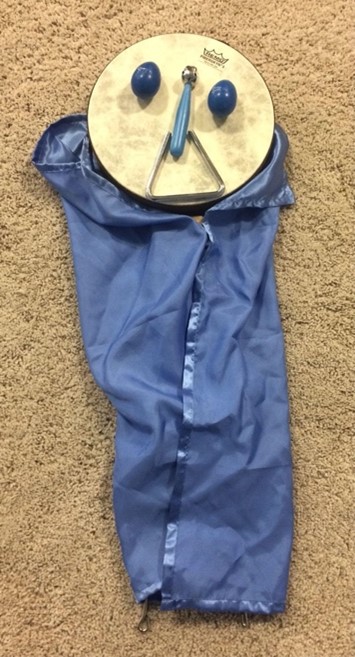
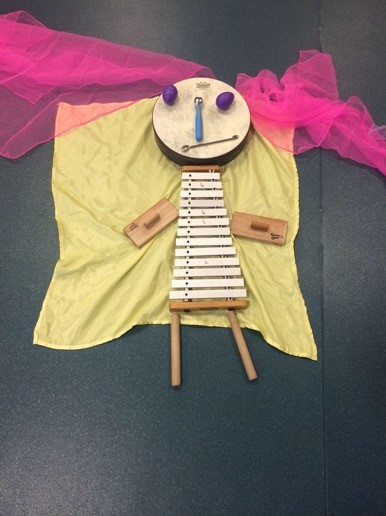
Kindergarteners love to explore touching and identifying instruments. This activity provides the structure for their exploration. First, we sing the song “Aiken Drum” and create new verses using food to make up Aiken Drum’s body.
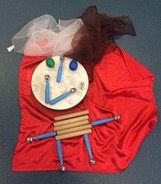
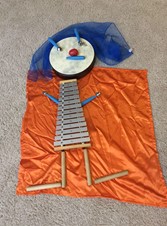
Then, we make “Aiken Drum” out of instruments. We make one as a class and insert the name of the instruments into the song (“his head was made of a drum”). After reviewing how we can take care of our class materials, I invite students to work with a partner to create their own instrument version of Aiken Drum.
Last, students take a gallery walk around the room to see everyone’s creation, and we come back together to discuss what we noticed. As you can see, one partner group decided to put Aiken Drum to sleep!
(inspired by Lopez, S. (2011). Blue is the Sea: Music, dance, & visual arts. San Francisco, CA: Pentatonic Press.
When handing out new props or instruments, I give children a couple of minutes to freely explore and play with them. Some of the best ideas have come from the students!
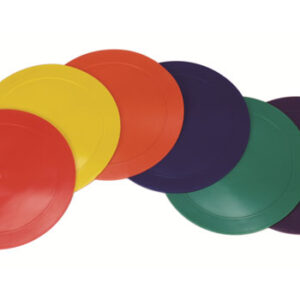
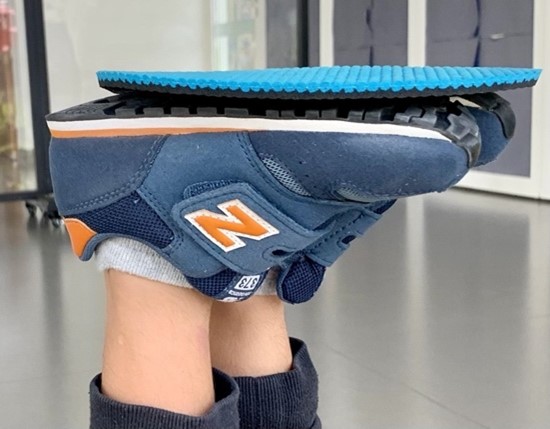
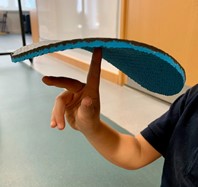
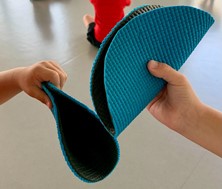
During this experience, children turned the dots into objects, including a taco, a telescope, and a hat. Others tried balancing the dots on different body parts or flipping them over like a pizza or pancake.
After free exploration, I led them through a guided exploration where we “glued” our dots to different body parts. Finally, we “glue” our dot to the floor to prepare for a creative movement game.
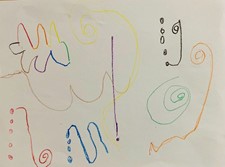
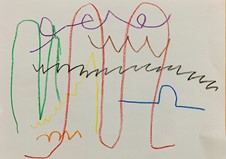
Over several lessons, we explored drawing our voices in the air, both teacher-led and student-led. Next, I guided the students on drawing their voices on paper, drawing lines and other shapes that match their voices.
Then, they could freely explore, drawing their voice on paper, resulting in beautiful lines, dots, and other surprises! The room was buzzing with sounds of swoops and loops. “Look at my voice…I’m going to make a zig-zag…I’m gonna make it swirly…Look! Look!” Finally, they shared their work with their partner.
As I stated in the last article, it is about exploring our own playful spirits and trusting that our playfulness will not encourage chaos but an unfolding of true creative potential. Will we feel vulnerable? Yes. Will it be messy? Yes. Will it be worth it? Absolutely.
Dearbury, J. & Jones, J. (2020). The playful classroom: The power of play for all ages. Hoboken, NJ: Jossey-Bass.
Goodkin, D. (2010). The ABC’s of education: A primer for schools to come. San Francisco, CA: Pentatonic Press.
Brown, S. & Vaughan, C. (2009). Play: How it shapes the brain, opens the imagination, and invigorates the soul. New York: Avery.
Resnick, M. (2017). Lifelong kindergarten: Cultivating creativity through projects, passion, peers, and play. Cambridge, MA: The MIT Press.
TEDx. (2017, December 1). Kindergarten for our whole lives|Mitchel Resnick
[Video]. YouTube. https://www.youtube.com/watch?v=IfvgVpQI56I
TEDx. (2015, January 21). Young programmers – think playgrounds, not playpens|Marina Bers [Video]. YouTube. https://www.youtube.com/watch?v=jOQ-9S3lOnM

Contributor
Tina Arenas teaches early childhood music and movement at the American School of Dubai. Prior to teaching abroad, she taught elementary general music in Texas. Tina received her Master of Music Education from the University of St. Thomas and…
Discover more from Tina Facebook
 Twitter
 Pinterest
 LinkedIn
 Email
Email Print
Print