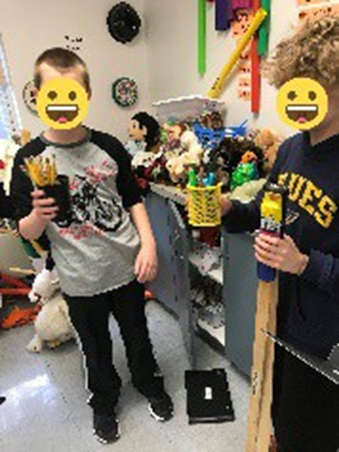
Collaborative student teamwork can improve students’ social skills, provide interdisciplinary opportunities, develop proficiencies according to aptitude and ability, hone leadership skills, and provide success for all learners.
Carl Orff, a proponent of creativity and child-based learning, was a strong advocate for group work. He stated the following reasoning:
Improvisation is the starting point for elemental music-making …with advanced groups, I tried to build up improvisations in several parts … Repeated practice and getting ‘played in’ to one another was necessary for this kind of music-making …. This continuous flow of forming and dissolving was the attraction of this ensemble exercise. (Orff, 1976)
Reflecting on my own music classes, I realize that group work was always one of my favorite teaching tools because of the joy of witnessing the following: student collaboration, child-centered learning, and students’ emergent leadership skills. Group work can often be one of the most successful elements in music education pedagogy if executed and planned thoroughly.
Collaborative student teamwork may strengthen learners’ outcomes through peer work. Group work can improve students’ social skills, provide opportunities for interdisciplinary activities, develop musical proficiencies according to aptitude and ability, hone leadership skills, and provide success for all — no matter their learning level.
Orff Schulwerk group creative exploration provides a crucial element in musical development. It allows students to utilize their strengths and work at their own pace. As we all know, not every child is comfortable with all aspects of music performance. Conversely, musically gifted students might find themselves bored with general music activities. By providing the avenues of group composition/improvisation, we enable students to collaborate and discuss their strengths and weaknesses.
For example, in my student group work, the group members discuss or journal about the strengths and limitations of all members and list them as they determine the assignment of parts. Students who have exceptional music skills can include more difficult rhythmic or melodic aspects, for example.
One of my favorite aspects of group work is witnessing students who do not like to participate in the whole group setting take an emerging role in group compositions, often obtaining new leadership roles as peer tutors.
Group work does take planning for execution, as well as classroom management. Because of this, many teachers are afraid to approach it. Instead of avoiding group work to alleviate these problems, we should be embracing them, even if it takes more time.
How to Get Started
There can be several approaches, but all successful group work calls for:
Making sure students feel safe to make mistakes in their composition efforts (Springer, 2013).
Being proactive about bullying, name-calling, laughing at mistakes, and other child behaviors that can be seen as an inhibitor to exploration and risk-taking.
Making sure directions are clear and that there is enough enrichment to add to the project so students are on task.
A means for student accountability and conflict resolution.
Group work rubrics need to include a section for individual participation. Both students and teacher should have this rubric.
Another means for accountability (journaling, etc.) Once it was available, I used Seesaw online portfolio.
Alternatives or strategies for students who are frequently absent or have social/emotional learning issues that make group work uncomfortable for them.
A Breakdown of My Group Work Approach
Assign groups randomly, and then tweak them to achieve a balance of ability and personality.
The students have a say in the groupings, to a point. (Letting me know if there are conflicts with another student, balance of orchestra or piano students, etc.)
The students journal or share what a successful group should look like.
The students journal or share how they will manage conflict.
I provide the groups with a timeline of each segment of the activity.
The students journal their progress.
If a group finishes before everyone else, they add enrichments to their projects.
The students practice their creation.
The students are recorded performing their creation.
The students watch their own videos and complete a self-assessment.
Fun sounds composition group work.
A group composition generally took a class 5-6 music days (one hour in length). I always took time to have a mid-class “checkpoint” to see how students were doing. Since my room was relatively small, I would often have individual group practices so they could hear themselves.
The other groups would then provide feedback. Group work could satisfy a variety of music concepts/targets, depending on the activity. For COVID safety, use masks, gloves, or keep disinfecting wipes handy. My Diamante Poem Composition Unitin Lesson Blueprints is a series of lessons using group work or you can also check out the additional resources on my website www.drstaffordsmusicalcures.com.
References
Orff, C. (1976). The Schulwerk. Tutzing, W. Germany: Hans Schneider.
Springer, D. G. (2013). Creative thinking in Orff Schulwerk. In C. Wang (Ed.), Orff Schulwerk: Reflections and directions, (169-182). Chicago, IL: GIA Publications.
Karen Stafford is a retired elementary music specialist, church music director, Teachers Pay Teachers seller, and adjunct professor from Union, Missouri. Dr. Stafford obtained her BME and MA from the University of Central Missouri and her Ph.D. from the…





 Facebook
 Twitter
 Pinterest
 LinkedIn
 Email
Email Print
Print