The music classroom contains a cornucopia of musical instruments, carefully curated by the music teacher to enrich students’ educational experience. Consider these ideas on how to easily take care of your barred instruments, secure funding for quality instruments, and locate resources for more information.
When students walk into the elementary music classroom, their eyes immediately scan the room to find the instruments. It’s no wonder since instruments come in as many sizes, shapes, and personalities as our students do! They must understand that the instruments in our rooms are tools for music-making and an investment that needs to be cared for regularly.
A Short History Lesson
The xylophone is an instrument that has been around for a very long time: the first official record of a xylophone was in Europe back in the early 1500s (Britannica 2019), but human beings have been hitting things for musical entertainment and enrichment since we could grasp a stick.
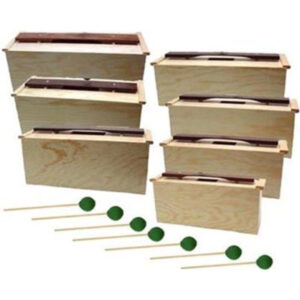
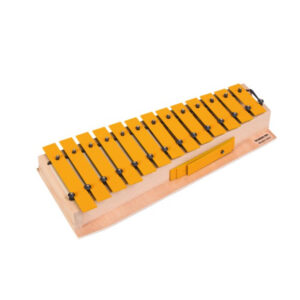
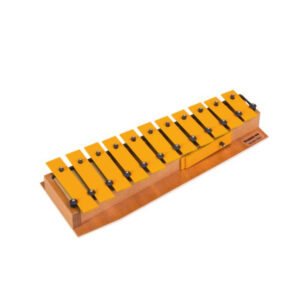
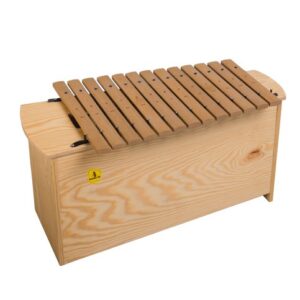
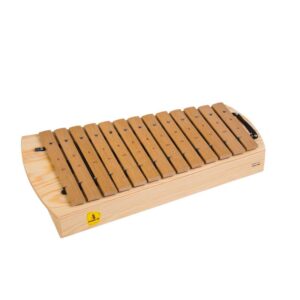
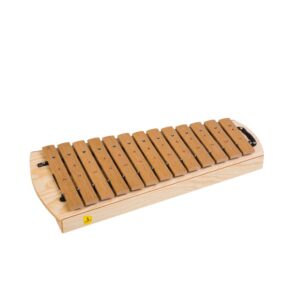
The xylophones we know and love to use in our classroom were designed for children by Carl Orff and Karl Maendler (Studio 49) to provide accessible and high-quality instruments for children to use. The pair specifically sized and pitched their instruments to cover the range of childrens’ voices yet also support them with a more orchestral sound by creating glockenspiels, soprano/alto/bass xylophones, soprano/alto/bass metallophones, and the contrabass bars.
Students enjoy playing a beautifully maintained instrument more than playing an instrument with cracks or buzzing sounds. Next, we will explore some simple and accessible actions to protect these engaging instruments in the general music room.
But, Really, Why?
“Why should I care so much about the xylophones? Barred instruments are designed to be hit with mallets. I’m sure they’re fine and will last a long time.” While technically, yes, xylophones and metallophones are meant to be regularly struck, it is also important to note that these instruments are made of breathing, malleable materials that need regular care to maintain.
Next, consider the cost of replacing these instruments: at the time of this article’s publication,* a soprano xylophone costs $420, an alto xylophone is $565, and a bass xylophone is $1295. Assuming your classroom has two each of sopranos, altos, and bass xylophones, that’s a $4,560 investment sitting in your music classroom.
If you have a full instrumentarium (4 each of SX, AX, BX, a set of contrabass bars, and 4 glockenspiels), that amounts to a $14,000 investment. In my experience, schools do not regularly refresh classroom instruments, so these instruments’ lives need to last for as long as possible.
*The prices referred to above are for Studio 49 Series 1000 instruments obtained from the West Music website – June 2021.
Cleaning Guide
A quickly implemented and instantly satisfying way to take care of your instruments is to clean them. Better yet, let your students help. Allowing students to participate in the process encourages them to have a vested interest in taking care of the barred instruments in your music room. I recommend deep cleaning your instruments once a year — either at the beginning or end of the school year.
I learned the most about cleaning instruments from Lissa Ray, a talented music teacher in Cincinnati, Ohio. Other information is from trial and error. When cleaning instruments, I’ll often find pencils, lots of dust, an occasional spider, and once there was a lost tooth container! Here’s a quick cheat sheet on how to surface clean your instruments:
Action
Applicable Instruments
Items Needed
Quick How-To
Remove dust/ foreign objects
Xylophones Glockenspiels Metallophones
Gloves (optional), vacuum with hose attachment
Remove all bars, set aside. Remove any large foreign objects (pencils, stickers, etc.) by hand and then vacuum every nook and cranny, including underneath the box/the bottom.
Clean wooden bars
Xylophones Contrabass Bars
Furniture polish spray or wipes, towel *if your bars are fiberglass, skip the furniture polish and wipe down with a damp cloth.
Remove bars and place on towel. Wipe down all six sides of the bars, and allow them to dry before replacing them.
Clean metal bars
Glockenspiels Metallophone
Windex wipes, towel
Remove bars and place on towel. Wipe down all six sides of the bars, and allow them to dry before replacing them.
Lissa Ray, mentioned above, has partnered with Teaching With Orff to create a video series called “Dr. Lissa” that goes into great detail about repairs you can do to your instruments. Whether you’re looking to remove some tarnish on a glockenspiel bar or to fix a crack in a bass xylophone box, she’s got a step-by-step video to help.
Now that your instruments are clean, I recommend designing an inventory sheet to help you keep track of the age, overall condition, and missing parts. This inventory can help you look for funding to replace or increase your room’s overall number of instruments. Additionally, it will help you remember how many pins or which instrument needs the tubing replaced when you ask your administrator for funds or set aside enough money from your annual budget.
Kristin Berger is a general music teacher at an elementary school in Ann Arbor Public Schools, in Ann Arbor, Michigan. She holds degrees in Music Education (BS), Vocal Performance (BA), and Secondary Education (M.Ed) from Xavier University in Cincinnati,…





 Facebook
 Twitter
 Pinterest
 LinkedIn
 Email
Email Print
Print