SUMMARY
Examine the process of teaching improvisation in this series of articles by Jeremy Howard. Part 7 introduces rhythm and Melody Improvisation Games.
by Jeremy Howard






Examine the process of teaching improvisation in this series of articles by Jeremy Howard. Part 7 introduces rhythm and Melody Improvisation Games.
by Jeremy Howard
In the last article – Part 6: Question and Answer Improvisation, we applied the improvisation processes timing, choice, and framework using Question and Answer. Now, it is time to take all that we have learned about the process of improvisation and learn some games to play with our students applying this new knowledge.
A Hyper-Speed Question and Answer Game!
Divide students into two equal teams (machines), Make one line – one group facing the other. If desired, you can have the first person on each team hold the Improv Builders visual of beats or rhythm set if a visual aid is needed.

The teacher sets a time limit and determines the tempo. Each team improvises question and answer style.
The first person on Team A improvises a four-beat pattern and immediately goes to the end of her line. The first person of Team B replies with a four-beat response and moves to his line’s back.
The players must move immediately after they have improvised, so their team’s next player is at the front, ready to go.
A player is captured and moved to the back of the other team’s line if they:
The game’s goal is to see which machine (team) has the least number of malfunctions within the pre-determined time limit set by the teacher.
Caterpillar is a cute activity that takes the fear out of improvising. Display the caterpillar with rhythms written on each of its body segments. The whole class reads the caterpillar as written.

Then, erase the rhythm on the last body segment. The whole class reads the first three segments, and an individual student improvises a rhythm for the final segment.
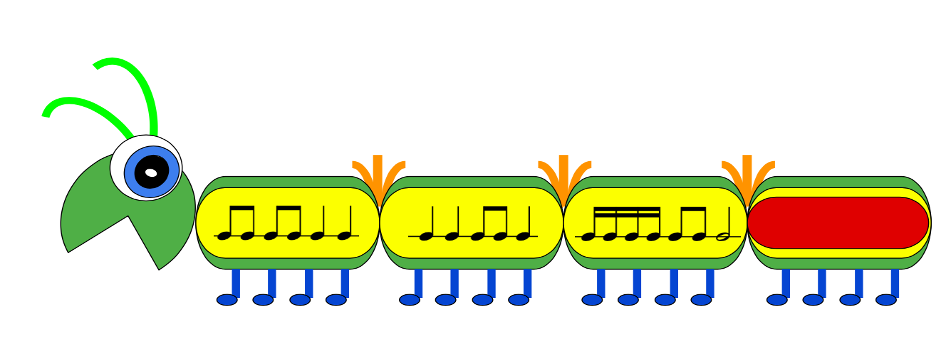
Next, the class reads two segments, and a different student improvises the last half. Continue this process until no rhythms are displayed on the caterpillar’s body, resulting in a student improvising the rhythms for the entire caterpillar!
This metamorphosis then changes the caterpillar into a butterfly!

Follow this link to create your own Improvipillar in Google Slides.
Kids love these markers! Designed to mark BINGO cards, they work perfectly to create melodic patterns on a staff.
Use Improv Builders staff cards to practice the tone set your students know (one line, two lines, three-line, or five-line staff).
Tell students they will be creating their music “on the spot.” Demonstrate singing and making dots simultaneously, so students see and hear the sound forming synchronously. Choose a student simultaneously sing and write her melody for the class, followed by the students echoing her melody.
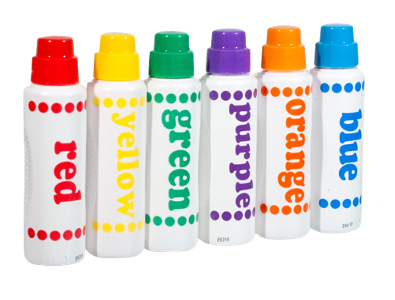

This activity allows students to explore improvisation kinesthetically by marking the staff aurally, hearing their sung melody, and visually seeing the dots.
As a bonus, you will have a set of melody cards created by students to use for reading and other classroom activities. Then students can take their musical work home to share with their families.
One could argue that this is a composition activity, which is true since it involves notating their creation. However, the creative process happens in real-time, or “on the spot.”
You’re training students to attach “sound to symbol” so when the children compose, they hear the music they write in the same manner they write words to construct sentences.
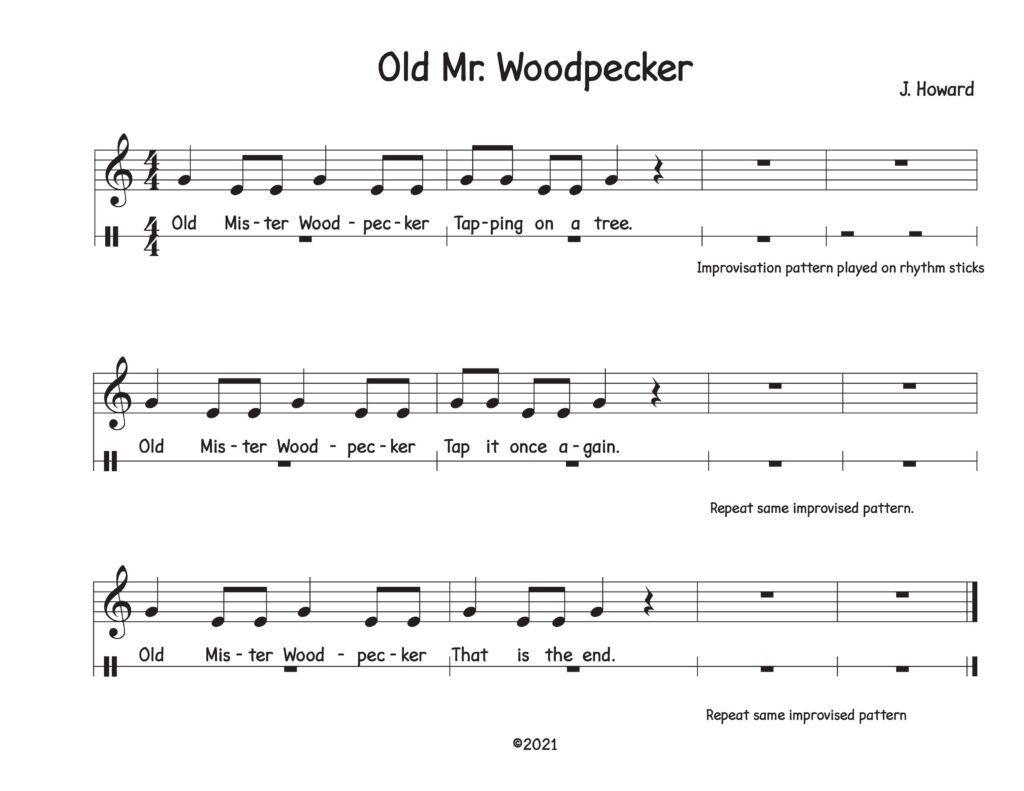
Old Mr. Woodpecker is an adaptation of an activity from Helen L. Wyzga’s Simple Gifts. I have changed this into an improvisation and decoding activity. The song’s rhythm set, tone set, and text make this activity ideal for first and second grade.
Students sit in a circle. Assign one student to be the woodpecker. The woodpecker is given rhythm sticks and uses the wood board’s picture with hearts to “peck” on the beats with the rhythm sticks.
The students sing phrase one, and the woodpecker taps his improvised pattern. Repeat the same process for phrases two and three. The woodpecker taps the same improvised pattern
At the end of the song, the class has heard the same rhythm played three times (which also happens to be the magic number of repetitions needed for students to memorize information). Now the students decode the rhythm they heard using rhythm syllables.
Adapt the same game using a tone set.

Closing:
Now that we have played some games using rhythmic and melodic improvising, it is time to put the complete musical puzzle of improvisation together. The last article of this series, Part 8: Putting the Puzzle Together, will give you the final pieces of the improvisation puzzle.
Part 1: Learning the Language of Music
Part 2: The Process of Improvisation
Part 3: Warming Up with Pre-Literacy Improvisation
Part 4: Pre-Literacy Improvisation in Songs and Stories
Part 5: Pre-Rhythm and Pre-Melodic Improvisation
Part 6: Question and Answer Improvisation
Part 7: Rhythm and Melody Improvisation Games
Part 8: Putting the Puzzle Together

Contributor
Jeremy Howard received a BME in vocal music education and an MM with an emphasis in the Kodály philosophy from Morehead State University and is a certified Kodály educator. Additionally, he studied at the Kodály Institute in Kecskemet, Hungary. Mr. Howard serves as the 3 Year-Old through 8th Grade…
Discover more from Jeremy Facebook
 Twitter
 Pinterest
 LinkedIn
 Email
Email Print
Print