Music Educators as Gatekeepers
This article talks about hidden curriculum as it relates to general music and offers strategies for identifying and rectifying the negative hidden curriculum in your
classroom.
by Erin Zaffini





This article talks about hidden curriculum as it relates to general music and offers strategies for identifying and rectifying the negative hidden curriculum in your
classroom.
by Erin Zaffini

Connecting music with other subjects is as old as time! Enhance your students’ educational experience while creating inclusive environments by adding STEAM to your lesson planning.
by Kathleen Staten
It was a Monday morning, and I had just wrapped up my normal beginning of class routines with my fourth graders. On a whim, I asked my students something I was wondering about over the weekend, “Okay, folks. Just out of curiosity, who do you think are the BEST composers?” They looked at each other and didn’t say anything. Clearly, they thought this was a trick question. “No, really. I want to know. Who do you think is the best?” A hand shot up from the back of the room. “Mrs Z.! Obviously the best composers are Beethoven, Mozart and Bach. You know. The greats!” Her classmates nodded in agreement. Okay. This was good information to have. But something was bothering me. Why did they think this? I never told them that these were the best composers, and yet, somehow they all agreed to it. It wasn’t until the end of the day when a realization struck me. Of course they thought those composers were the best! No, I didn’t say those exact words to them, but I might as well have. I said it through the decisions I made as their teacher during each class. I said it everytime we did active listening and I picked a composition from one of those three. I said it when I asked students to bring in examples of pieces in different musical forms and recommended that these types of composers would be acceptable musical choices to bring to class. And although I didn’t intentionally teach them that these composers were the best, my messaging was loud and clear. It made me wonder—What other messages was I giving to my students without even realizing it?
As music educators, we have immense power. We are gatekeepers in many ways. All of our choices, whether we mean to or not, send messages to our students about what we value and what we deem is important in music education. These implicit messages, values, and behaviors that are communicated in the classroom through what is taught—or not taught—and how it is taught, often go unnoticed because they are not part of the formal curriculum. Yet, they shape students’ perceptions of what and who is valued.
In music education, hidden curriculum is pervasive. Every music teacher has it. It’s unavoidable. Sometimes the hidden curriculum is good. Sometimes our teaching aligns with our philosophies of music education and what we hope to instill in our students. Students feeling like they can try new things in music class and learn, grow and become better with dedication and persistence? That’s a message I can definitely get behind. Students who leave my class thinking that there is only one way to be a musician? Not so much.
It’s the negative hidden curriculum that can hold our students back from growth, inclusion and belonging when it comes to music education. For example, through our repertoire choices, we define for our students which genres and styles of music are worthy to be included in our music classes and ensembles. When we don’t purposefully acknowledge and include the music our students participate in or connect with outside of school, we can unintentionally send the message that the music they love and value is not good enough or worthy enough to be included in school music programs. The scheduling of ensembles is another example. Though frequently out of our hands, many schools’ or districts’ decisions about which ensembles are scheduled to rehearse during the school day and which ones are slated as before or after school activities can send specific messages to students. Including choir, band and orchestra during the school day is much easier for many of us while ensembles like rock band, laptop orchestra and steel drum ensemble are forced to rehearse before or after school, making these ensembles inaccessible for students who do not have the capability to get to school early or stay after. The hidden message we’re sending? These types of ensembles and this type of music making are not valued enough to be included during the school day. If they were, all students would be allowed access to them.
As the school year continues to unfold, many of us find ourselves reflecting on our teaching practices and wondering about what steps we can take to improve our practices. Consider making some changes related to the hidden curriculum you might be conveying to students.Try conducting a hidden curriculum audit. As music educators, we possess the power to uncover these hidden messages and take steps to address them. By engaging in critical self-reflection, examining our teaching practices, and evaluating the curriculum we deliver, we can make intentional changes that align with our educational values and the diverse needs of our students. A hidden curriculum audit is an effective way to begin this process. It allows us to take stock of what is happening in and outside the classroom, giving us a clearer picture of which values and practices we are prioritizing—and which we may be unintentionally excluding.
Here are some questions to consider during your audit:
These are essential questions because the hidden curriculum is as much about what we exclude as what we include. When we emphasize certain genres or skills, we inevitably overlook others. By shining a light on these choices, we can begin to diversify our curriculum and promote more inclusive practices.
One of the tools I have developed to help music educators in this process is the “Hidden Curriculum Inventory.” This inventory allows teachers to assess their current teaching practices and identify areas where hidden meanings and messages may exist. It serves as a simple but powerful way to take stock of what’s happening in the classroom, offering a structured approach to uncovering both what is included in your teaching and what is left out. I’ve included this audit template as a free download for you to use with your own classes.
Use the tool as “dumping ground” for everything that is currently happening in your classrooms and ensembles, and as a result, what is not. For example, in the “What’s In” column, write out everything that you currently do throughout the year with your students. Then, in the “What’s Out” column, write in the things that are not happening or being included. To be clear—there is no possible way to include everything in your music class. This document is meant to be a tool to uncover topics, skills, repertoire, teaching strategies, etc., that you might want to try to make space for in the future.
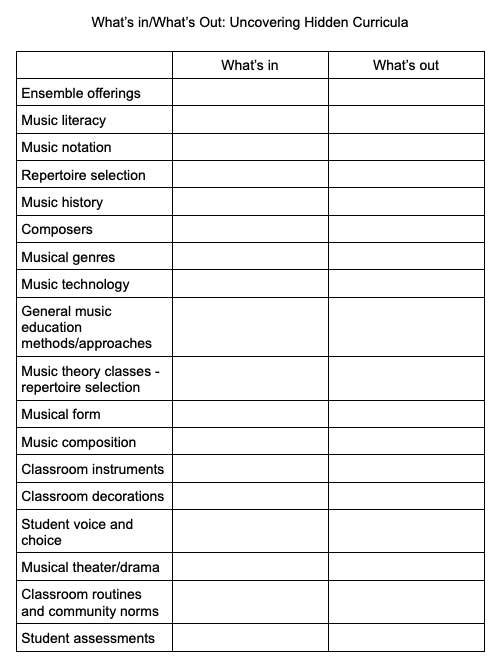
For years, I had centered my fifth-grade curriculum on jazz and blues, presenting these genres as the primary spaces for improvisation. Using the hidden curriculum inventory, I wrote “jazz” and “blues” in the “What’s In” column. Then, I began to list other genres—reggae, Indian ragas, gospel, and flamenco, to name a few—in the “What’s Out” column. After completing the inventory, I realized that my teaching was excluding other musical traditions that also emphasize improvisation. This small but meaningful step led me to expand my improvisation curriculum to include a broader range of musical styles. Not only did this enrich my students’ musical experiences, but it also helped me break down some of the implicit hierarchies I had unknowingly perpetuated.
The hidden curriculum is ever-present, and while we may not be able to address every aspect of it at once, small, intentional changes can lead to meaningful improvements in our teaching practices. As you continue the wonderful work you do during the school year, consider identifying one or two areas of your curriculum that could benefit from revision. Here are a few practical suggestions:
The process of uncovering and addressing the hidden curriculum can be both rewarding and eye-opening. It encourages us to re-examine our practices and see our teaching from a fresh perspective. While we can’t change everything overnight, taking the time to audit our curricula allows us to make incremental changes that promote inclusivity and equity in our classrooms. Even the smallest shifts in practice can have a profound impact on your students and your teaching journey. Happy searching!
Want to connect with Erin to get some needed support for yourself, your school or your district? Feel free to reach out to Erin at www.erinzaffini.com to schedule a phone call!

Noteworthy Contributor
Dr. Erin Zaffini is the Director of Teacher Education for Longy School of Music’s online and on-campus Master of Music Education degrees, online Certificate of Advanced Graduate Studies, and Teacher Continuing Education. She is also a faculty member for…
Discover more from Erin Facebook
 Twitter
 Pinterest
 LinkedIn
 Email
Email Print
Print