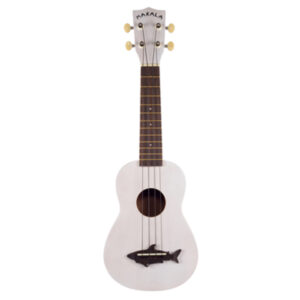
Initially, understanding the purpose of the parts and pieces will assist you while teaching your students. As you become a more proficient player and want to invest in a different instrument, this information will help you find the perfect ukulele for yourself.
by Kate Hagen
Ukulele: The Basics
When teachers first contemplate teaching the ukulele in their music classes, they are frequently overwhelmed with the logistics of starting a program. However, the first consideration should be the goals and objectives you hope to teach. These decisions will help you articulate the purpose of adding this instrument to your general music classroom and provide the rationale to ask for funding if needed.
Are you looking to start a ukulele program in your school but unsure where to start? You don’t need to be an accomplished guitar/ukulele player or have a big budget to add ukulele to your curriculum. Here is what you need to know if you are considering starting ukulele with your students.
Ever wonder what the different pieces of your ukulele are called or what they do? Continue reading and discover the purpose of each part that makes this instrument so enjoyable to play!
Head: (Headstock) is at the ukulele’s top and supports the tuners. It needs to be a sturdy piece of wood or plastic to withstand the tension of the strings on the tuners. The headstock will either be solid or slotted. The style will not affect your ukulele’s tone but will change the positioning of the tuners.
Tuners: (Tuning Pegs, Pegs, Tuning Keys, Tuning Heads) are attached to the head of the ukulele and hold the strings in place. Twisting the individual tuners tightens and loosens the ukulele’s corresponding string to raise or lower the pitch to bring the string into tune.
Nut: Your ukulele would be unable to make a sound without this valuable part! The nut is a thin ridge that lays perpendicularly between the headstock and the neck. The four grooves carved into the nut prevent the strings from sliding around, keep the strings spaced correctly, and slightly lift the strings off the fretboard, allowing players to press the strings to produce different notes.
Fretboard: (Fingerboard) is a thin piece of wood or plastic lying on the neck. The fretboard holds the frets and allows the ukulele to produce different notes depending on where you press the string. The closer the note is to the body, the higher the pitch, and the further from the body, the lower the pitch.
Frets: These thin metal bars lay perpendicularly across the fretboard under the strings. The frets are hammered into the fretboard, allowing musicians to find specific notes. Fun Fact: Ukuleles can only play notes a half-step apart, unlike their fellow string instruments like the cello and violin.
Fret Space: As the name implies, this is the space on the fingerboard between the frets. It is also where the string is pressed to form a single note or chord.
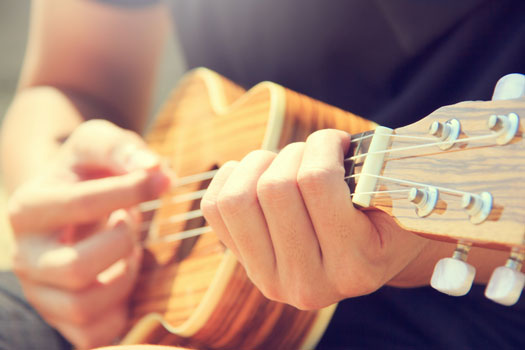
Neck: This part connects the head to the ukulele’s body and holds the fretboard. It is made from a single piece of wood or plastic. Musicians hold the neck with their non-strumming hand and use their fingers to press the string to create chords while pressing the back with their thumb.
Strings: These are plucked or strummed to create the vibrations sent through the sound hole to make sound. Made from nylon, the strings run from the tuning pegs to the bridge of the ukulele and are tuned to the pitches C, E, G, and A.
Body: The body amplifies the strings’ vibration when strummed or plucked. Made of wood or plastic, the body has many shapes and sizes and is the largest part of the ukulele; the type of material and shape can alter the sound quality.
Sound Hole: This is the large hole in the center of the ukulele’s body. The sound hole helps amplify the sound, which is why it is recommended that you strum the strings between the end of the neck and the sound hole.
Bridge: This strip of wood or plastic is located near the bottom of the body, right beneath the sound hole. The bridge secures the strings to the ukulele’s body and helps the strings vibrate.
Saddle: This sits on top of the bridge and has a similar purpose as the nut on the head of the ukulele. The saddle keeps the strings separated and leveled across the whole ukulele.
Initially, understanding the purpose of the parts and pieces will assist you while teaching your students. As you become a more proficient player and want to invest in a different instrument, this information will help you find the perfect ukulele for yourself.
Happy Teaching!
References
KALA. (2020, August 18). Parts of the ukulele. Kala Brand Music Co.TM. https://kalabrand.com/blogs/tech-and-how-to/getting-to-know-your-uke
Roberts, A. (2023, November 30). The different parts of the ukulele: Anatomy and structure. Hello Music Theory: Learn Music Theory Online. https://hellomusictheory.com/learn/parts-of-the-ukulele/
Kate Hagen currently teaches in the Iowa City Community School District. She has 20 years of experience working with K-6 students in public schools. Kate has a license in Music Therapy from the University of Iowa, and a Masters of Music Education from University of…





 Facebook
 Twitter
 Pinterest
 LinkedIn
 Email
Email Print
Print