Teachers can easily lead collaborative creative group activities in Language Arts classes with “shared stories.” What is the musical equivalent, and how can we share this work with parents and administration? Adding loopers to our classroom toolbox is an innovative way to accomplish both goals.
by Jim Oshinsky
Teacher Toolbox
What is Looper?
Students at elementary and middle school levels are used to taking home their own original artwork from school. But, they rarely have the opportunity to bring home any original music. Looping can easily preserve the creative contributions of students. Find out how to use a looper in your classroom for high student engagement and success.
Teachers can easily lead collaborative creative group activities in Language Arts classes with “shared stories.” Each student, in turn, adds a sentence to the story, which can lead to spontaneous shifts in the narrative that are entertaining and engaging. Ultimately, the students have a creative product in which they share authorship. What is the musical equivalent? How can music teachers create an analogous experience?
Rhythmic Improvisation Circles
Picture a timeline. The timeline is often linear in a literary narrative as we follow characters and events. The story builds into its own future. In a musical “narrative,” it is possible for students to add to each other’s melodies and motifs. However, this requires high levels of technical skill to remember, reproduce, and relate to their peers’ contributions. Adding vertically to the timeline rather than linearly is a much simpler task, and it relies on having a steady rhythm as a scaffold to build on.
The instructor starts a metronome to provide a steady pulse. The first student is given a few seconds to “noodle around” along with the pulse to settle in on a simple repeated pattern that leaves space for their classmates to add their ideas. Once the first student lands on a workable pattern, they continue it for the duration of the activity.
The following student repeats the same process, with the freedom to “noodle” and experiment with rhythm, settling in on their own repeated pattern. The sound will get denser as more students enter the group composition, and the “holes” in the pattern become more of a puzzle to find and fill tastefully.
The options for participation will always include the following:
Supporting the basic pulse.
Adding multiples or divisions of the pulse.
Adding harmony.
Answering a phrase in a conversational style.
Imitating or doubling an existing phrase.
Some contributions, such as a counter-rhythm or triplet over duple meter phrase, open up the whole composition to new areas of exploration. Eventually, every student contributes a pattern to the aggregate whole, with each student’s repeating pattern guided by a steady pulse. This type of community composition is a fine metaphor for inclusiveness, in that every person’s contribution is welcome and helps enrich the other contributions via contrast and support.
Once students are comfortable performing these pattern-on-pattern layers, the teacher’s ability to play within the ensemble becomes endless. The teacher can stop the whole group dramatically on one definitive downbeat or play with the ensemble as a production in the mixing studio, experimenting with temporarily fading specific students’ parts to better hear the interplay of other parts. The piece can end with a fade out, a crescendo, or having students drop out in reverse order to how they entered the music.
Some groups will need help to sustain a reliable rhythm for sufficient time to permit everyone in the whole group to contribute a part. However, each person can likely play their part in good rhythm, at least once.
Digital Solutions for a Common Problem
Students can require assistance sustaining a reliable rhythm for sufficient time to permit everyone in the whole group to contribute. Consider adding a Looper.
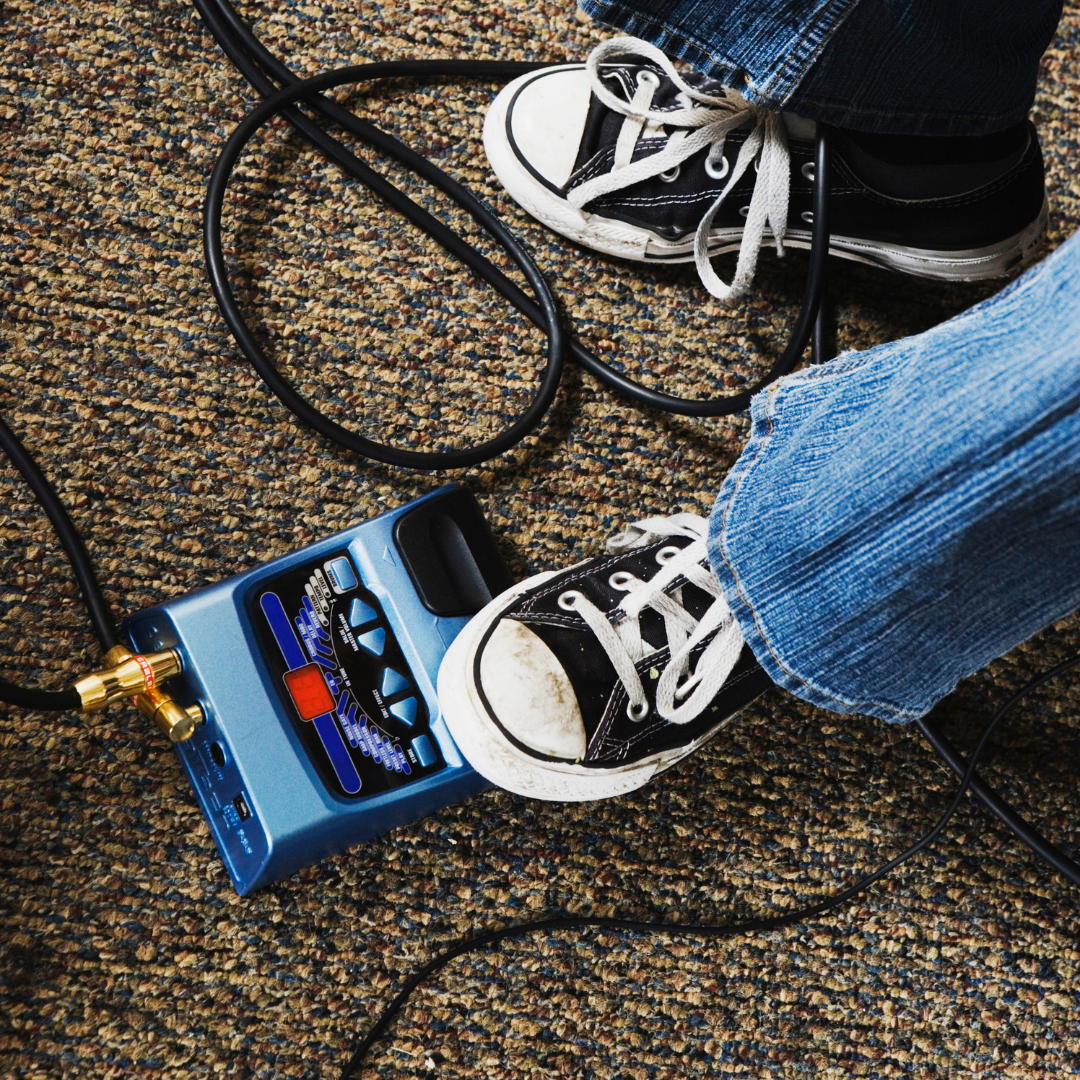
The looper is so convenient because it captures the music in real-time, on the fly. Loopers are often floor pedals, similar in design to other effects electric guitarists use. A foot switch on the looper box is dedicated to starting and stopping the recording. Suppose the looper is programmed to repeat the recording immediately. In that case, there will also be a foot switch that stops the output of the looped sounds while the original signal still plays.
There is also a foot switch that will undo the last recorded loop in case of an error and a foot switch that erases the whole recording to allow you to start over. Most loopers have memory locations that permit you to store loops and play them on demand or move them to other devices.
Instead of building a traditional rhythm circle activity described above, the first person’s rhythm is captured with the looper. The following person plays along with the looped rhythm until they “fill a hole” in the sound. The teacher adds the new contribution to the repeating loop by overdubbing and then passes the mic to the next student.
Each student listens for a new hole to fill or a new way to complement the existing looped sounds. Additions to the composition can include doubling a part, adding harmony, supporting the basic pulse, or creating a new layer. The group composition is easy for a teacher to assemble, and like a group story, it is a cooperative creation that all the students contribute to.
Students are fascinated when hearing their contributions to the composition recorded and played back to them. Recordings also provide opportunities for the teacher to complement their students for their musicality, such as their intensity of expression or unique timbre.
As a bonus, looping can easily preserve students’ creative contributions and allow them to share their original music with their families.
Additional Classroom Applications
Create a steady pulse that students imitate, tapping on their laps. Provide calls, which the students echo back in a call-and-response manner. Next, introduce a variation. Instead of responding with an exact repetition of the teacher’s call, each student comes up with their unique rhythmic response – creating a call and answer instead of a call and echo back.
After all students have had a chance to provide a unique answer, the teacher repeats the activity, starting with just the beat and no calls. Students volunteer to provide the call. The teacher captures that call with the looper, using a period twice as long as the student’s call.
For example, the student gives a four-beat call, and the teacher adds another four beats of silence before ending the loop recording. What repeats is the student’s call, followed by four beats of silence. The beats of silence allow space for the rest of the class to echo each classmate’s recorded call or to answer and converse with it.
If adding a looper to your classroom has piqued your interest, you can find more information about looping as a musical practice at Looper’s Delight. Or, to learn more about the technical aspects of a looper, read What is a Looper?
James Oshinsky, Ph.D. is a psychologist and musician. He teaches improvisation at Adelphi University. Jim is the author of Return to Child, a book detailing the improvisation pedagogy of the late cellist David Darling and the organization, Music for…






 Facebook
 Twitter
 Pinterest
 LinkedIn
 Email
Email Print
Print