SUMMARY
Audiation or reading from the staff: which method works best for teaching recorder? Look at the research, decide for yourself, and maybe learn some new ideas along the way.
by Karen Stafford





Audiation or reading from the staff: which method works best for teaching recorder? Look at the research, decide for yourself, and maybe learn some new ideas along the way.
by Karen Stafford
Note: The term “recorder” references a C Baroque soprano recorder.
A survey of 219 music teachers from various Facebook music teacher groups indicated that 72% of the people start with audiation instead of reading pitches on the staff, and 64% use solfege when beginning recorder. Based on my own observations in the classroom, I am forming the opinion that the practice of using a recorder right away to read pitches may be giving way to audiation. Starting with different pitch sets as described in Teaching Recorder: What Pitch Set Should I Use? may influence whether teachers start their students by eye or ear.
When determining which approach to take, ask yourself these questions:
When I first started teaching recorder to fifth and sixth graders, I used recorders that included the little red book and cardboard stand. Students worked through various songs simultaneously, like many beginning instrumental ensembles.
The kids started with B, then A, and them G. I had them for 35 minutes, 2-3 times a week. The motivated kids loved it but got restless, waiting for everyone. The kids who could not keep up ended up shutting down or causing problems because I wasn’t meeting their needs.
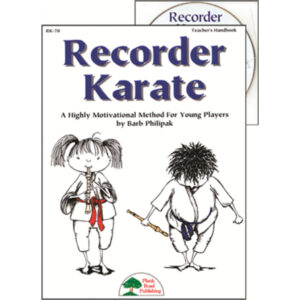
I switched to Recorder Karate, published by Plank Road. By this time, I was working with a different population, but they LOVED it. I remember one girl who had kept all her belts from fourth through sixth grade, and they dragged down the hall tied to the bell of her recorder like a giant snake.
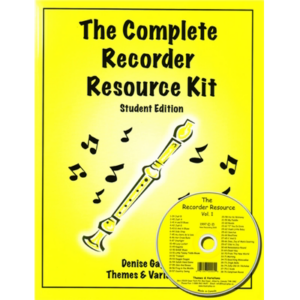
Still, even though the students worked at their own pace, there were issues with differentiation. Over time, I adapted the concept of Recorder Karate by making packets for each grade, 4-6. These packets contained specific resources labeled by belt: fourth grade had BAG songs with various rhythms (from Recorder Resource by Denise Gagne and K-8 Magazines); fifth grade included easy E songs and introduced low C and D, and sixth grade had high C on up. I also added “tooter tutors” and various ways to earn beads.
Students could play advanced songs for beads if they passed the black belt. My students who had difficulties thrived with a peer helper (students had to achieve a certain belt level to be a tutor).
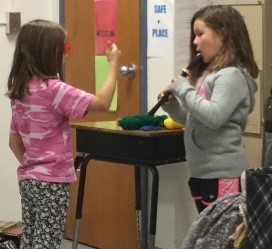
The students who zoomed through the packets found new challenges in playing along with a CD. Also, by this time, if a student in fifth or sixth grade had reached at least the fourth belt from the end of the previous year, they had the option to play alto, which had its own packet.
This whole time, I used the recorder directly in conjunction with teaching pitches on the staff. I found that reading from the staff was the biggest struggle. Students could not ask me to label pitches. I allowed students to add labels to a certain degree if modifications were needed.
However, by fifth grade, I expected students to understand the staff better. It didn’t work that way because students did not understand the aural concept of intervals. Plus, several of my students could not focus on using their fingers and reading the staff simultaneously.
I attended an Orff workshop where the clinician advocated AC’D and was inspired to change my current practices. I didn’t want to change my well-established routines, so instead, I started introducing the recorder in third grade.
At the time, I was also learning more about Edwin Gordon’s theories of audiation, so in third grade, I started introducing the recorder using songs they learned in first grade. First, students had to sing them (closed soft-pallet: C’). We would also play the corresponding singing games.
Next, I came up with a belt list for the third graders but did not use a packet since they were not reading the music. As time went on, I became a believer in starting beginners on EGA (mainly warm tone and right hand), so I switched.
Third graders could handle the singing range too. This approach worked much better for my students and me. Additionally, I incorporated Curwin hand signs and later had students work in pairs and record them into their Seesaw online portfolios.
To earn the bead incentive, the songs students had to play introduced a single B on the staff. I decided to use this approach because B is an easy choice for the fourth pitch from either starting pitch set. Additionally, students could get a sneak peek of the staff because they had already learned intervals on staff with solfege.
The method you use to introduce the recorder depends on your schedule and population. Just remember – no matter what method you choose:
And a patient teacher who doesn’t mind a few squeaks.

Contributor
Karen Stafford is a retired elementary music specialist, church music director, Teachers Pay Teachers seller, and adjunct professor from Union, Missouri. Dr. Stafford obtained her BME and MA from the University of Central Missouri and her Ph.D. from the…
Discover more from Karen Facebook
 Twitter
 Pinterest
 LinkedIn
 Email
Email Print
Print