SUMMARY
If It Has Words, You Can Musick! Find improvisation inspirations in objects lying around your house, classroom, or school library. All you need are words from printed media!
by Karen Stafford





If It Has Words, You Can Musick! Find improvisation inspirations in objects lying around your house, classroom, or school library. All you need are words from printed media!
by Karen Stafford
As an Orff teacher, I was pleased to see the updated National Standards for Music emphasize creativity and improvisation more than before. After all, that is the top of Bloom’s Taxonomy and very desirable in the workforce.
However, implementing improvisation, creativity, and composition can seem daunting. The planning! The notation! The music theory! But did you know that you can design improvisational and music-reading activities simply using objects lying around your house, classroom, or school library? All you need are words from printed media.
Using a series of words can meet many music class requirements: identifying correct rhythm patterns, determining meter, using solfege, identifying form, using folk songs that are on topic with the words, etc.
You can make this approach as straightforward or as advanced as you prefer. Students can work individually, with a partner, or in groups, depending on your class, their level, and the number of students.
Some student-appropriate resources for finding words can be:
I define the extra descriptors that come to mind when thinking about a subject as extensions. For instance, the extension words can be descriptive (slimy, crawly) or environmental (on the ground, hibernate) on a book about snakes.
You can supply the words or materials, but it might be better for older students to do this if you are looking to newspapers or magazines for sources. If you do this, however, you will need to set parameters based on the responsibility level of the students in the class.
Helpful hint: Review the material before you use it, or you might have some explaining to do!
Helpful hint: Use individual words or create word chains depending on the meter.
Choose one of the following ideas instead:
Helpful Hint: The “volumes,” as Orff people call them, are purposefully written to encourage improvisation, not to be played or sung verbatim. Use one of the melodies (or part of a melody or tweak a melody) and add words. Better yet, see if your kids can create a verse as a class and modify it as necessary.
I used a book called Snail Trail: In Search of a Modern Masterpiece as a cross-curricular activity with first graders. In the picture, you can see the index cards with printed pictures to assist students while notating the rhythm of their text using craft sticks.
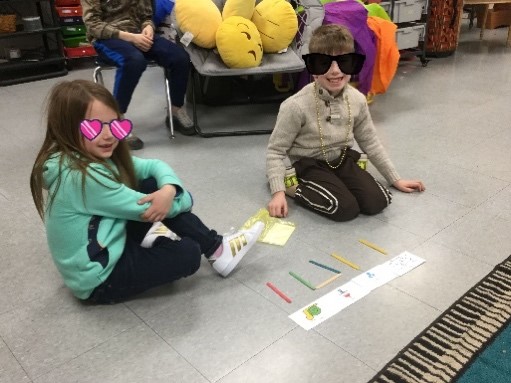
We used the song “Snail, Snail” for the A section. However, instead of playing the familiar game, the students would walk in various pathways (zigzag, straight, curved, etc.). Then each group performed their composition for the alternating sections.
With fifth-grade students, I have successfully used characters of Minecraft. Students identified and notated the rhythms of the characters. Instead of performing a rondo, I used the word chain idea as a simple review assessment at the beginning of the year.
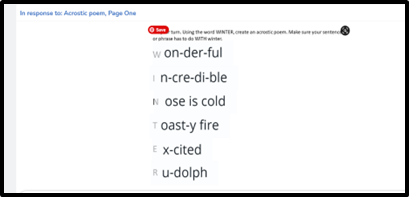
In this example, a third-grade student created an acrostic poem. This type of poetry is simple for students to create in response to a book, song, or poem.
We expanded this project by creating a melody by adding pitch names to each note and submitting their composition on SeeSaw. Students were able to work at their own pace because I could give step-by-step directions for students to follow.
These projects can be designed to fit the need of your classroom perfectly. Each project can cover multiple objectives: a rhythm review, solfege, form, and even expression. You can use words for rhythm review, as I did in fifth grade, creating source material yourself or asking students to find a theme.
Students can use text to explore simple forms of poetry such as haiku, acrostic, or diamante poems. You can ask the students to create body percussion with the rhythms and then layer the parts.
Use SeeSaw as an online portfolio. Post your directions using single-step instructions to hold students accountable. (See this example.)
Composing and improvising with text is one of my favorite activities with students. These activities can be as simple or complex as you want to make them; depending on what you choose, it can take very little prep time or an hour or two. They also provide excellent opportunities for students to contribute to their learning.
The possibilities are endless using a few simple words!

Contributor
Karen Stafford is a retired elementary music specialist, church music director, Teachers Pay Teachers seller, and adjunct professor from Union, Missouri. Dr. Stafford obtained her BME and MA from the University of Central Missouri and her Ph.D. from the…
Discover more from Karen Facebook
 Twitter
 Pinterest
 LinkedIn
 Email
Email Print
Print