When writing and interpreting notation, musicians think creatively and deeply about how a piece might sound. Guided by Universal Design for Learning principles, alternative notation can engage students in musical literacy through playful exploration.
by Hanako Sawada
Two Lessons Using Playful Notation
These lessons using UDL principles are also available as a FREE Lesson Sketch!
Universal Design of Learning (UDL) is a framework to improve and optimize teaching and learning for all children based on scientific insights into how humans learn. This educational approach uses scaffolding to make learning inclusive and accessible for all students. Join Elise Hackl-Blumstein for an introduction to implementing UDL in the general music classroom.
What comes to mind when you hear the word “playfulness”? Perhaps you imagine improvising on Orff instruments, performing found instrument soundscapes, incorporating music technology, creating listening maps, or using paper cups for rhythmic reading.
One way that musicians have and continue to embody playfulness as a part of their practice is how they notate musical ideas and interpret musical notation. Activities such as listening to well-known pieces as animated graphic scores or looking through compositions documented as graphic scores demonstrate how musicians can transcend their mastery of a highly-curated canon. Indeed, musicians also engage in other creative processes as the purpose and product of their work.
Designing play with intentionality can look messy; it can take time but “speed up” conceptual understanding; it can be low- or no-tech but produce innovative thinking. Such experimentation can produce the unexpected but embody success.
Play also does not have to compete with implementing classroom management strategies, traditional ensemble playing time, or teaching healthy posture and technique. Rather than complete freedom, simple structures can cultivate a playful yet rigorous ecosystem for student-driven musical learning.
“How can we share our musical ideas?”
We often introduce iconic notation to meet the developmental needs of our young learners, but more broadly, it can simulate what “real” composers and musicians utilize and interpret. Exploring notation provides natural pathways to further inquiry (within itself and to other topics) and interdisciplinary collaboration.
More specifically, in music education, Brian Dennis’ book titled Experimental Music in Schools and the BBC feature, “Shoreditch: Experimental Music School, 1969,” document examples of alternative notation and playful interpretation of notation in action for young learners (from over 50 years ago!).
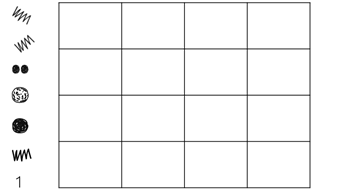
Source: Adapted from Experimental Music in Schools: Towards a New World of Sound (Dennis, p. 44)
Simple parameters can lead to thought-provoking, open-ended, and deep thinking. The grid above provides the structure for students to create their own body percussion pieces.
As a starting point, as a class, we used the symbols as shown on the left and started to assign specific movements or sounds to each symbol. Students then asked questions like:
What if we use the same symbol but in a different color or size?
What if we put more than one icon in a box?
What if we draw a different picture or a word?
What might a “long” figure (e.g., zigzag line) sound like compared to a “short” figure?
Can I add [repeat signs, crescendos, rests/blank boxes, etc.]?
Then, students notated, then performed for one another, then performed sometimes together. Unexpectedly yet naturally, my students posed their performances like a guessing game to their partner, asking them to guess what a specific icon represented (e.g., “Watch my piece [the paper and the movements] and try to guess what sound I make for the blue star!”).
Some developed “keys” to record and describe each sound, applying their learning from other areas into musical content. Students used a wide range of icons and identified patterns that I would have never imagined.
If students write on paper (rather than on a digital platform), students can turn their piece upside down or cut the paper into strips or squares to rearrange them. The possibilities are endless! Manipulating the composition generates works of art that make musical thinking visible.
Explicitly permitting students to experience music in this way – how they express sounds with their body and how to represent sound – inclusively provides multiple means of engagement, action, and expression (About Universal Design for Learning, 2021). It may perhaps be less daunting than having little to no parameters in writing or performing graphic scores that generate infinite possibilities.
“How have composers expressed their music?”
The first task introduced works hand-in-hand with the wondering: How has written music varied by time, location, genre, and preference? By showing examples from traditional Western notation to musical braille, students learn that “real music” is diverse in how it looks and sounds. Students started asking, “That is music? It looks like art! How does it sound?”
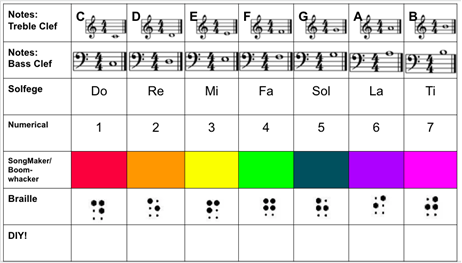
Sample “key” and summarizing various ways of writing pitches
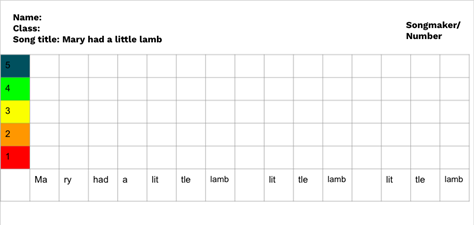
Sample exercise of using colors and/or numbers to represent notes in “Mary had a little lamb” (note letters or traditional notation of the song provided)
The table above provides my students with a key to decode pieces and “translate” a song in various forms of notations. They engaged in the Mary Had A Little Lamb exercise as if it were a puzzle of decoding patterns, much like when kids invent a secret alphabet to send an exclusive message to their friend. This process creates a clear opportunity for students to connect various forms of notation used in our classrooms, such as colors, numbers, letters, and solfege signs.
Some students created their own systems of notation for notes, similar to the first task. There are countless ways to adapt these exercises to meet students’ strengths, needs, and interests. Students achieve music literacy, but moreover, these activities display the diversity that exists in music and reveals how musicians need competencies like decoding, visualizing, adapting, and playing.
By regularly incorporating musical play, such small shifts ensure our practice “reflect[s] the actual processes in which musicians engage.” (National Association for Music Education, 2021). Each of the interchangeable tasks externalizes concepts and discretely allows students to learn music theory.
Helping students observe, listen, analyze, and express. Introducing a wide range of representations of music. Such learning goes hand-in-hand with multiliteracies needed in a multimedia world. In this way, not only are we fulfilling our job of teaching the standards, but we are learning with our students to play in our practice and expand our thinking.
Hanako is an international music educator who continuously questions and explores creative learning in and through the arts. She received her B.M. Music Education and Performance from the University of Miami Frost School of Music received her Ed.M. Arts…






 Facebook
 Twitter
 Pinterest
 LinkedIn
 Email
Email Print
Print