Every minute of every lesson is essential, especially given the amount of time we see our students. Enter, the transition, which will allow us to capitalize on students’ love for imaginative play while weaving between activities like a New York taxi driver!
by Jeremy Howard
First, We Sing! Book Collection
The We Sing Collection focuses on Kodály-Inspired Teaching and provides guidance and direction for new teachers using the Kodály approach.
Every minute of every lesson is essential, especially given the amount of time we see our students. Add to that the myriad of concepts we wish to instill to create musically literate students — all of it: reading, score copy, composition, dictation, improvisation. Now, don’t forget to include repertoire allowing for exploration of the world around them and plenty of music for joy: singing, dancing, instrument playing, games, and stories. With the many experiences we provide, how can we sculpt a lesson that is streamlined and has flow? Enter, the transition, which will allow us to capitalize on students’ love for imaginative play while weaving between activities like a New York taxi driver!
What is Transition?
A transition is a sneaky way to link songs, storybooks, and activities together in a seamless manner, allowing you to take your students from “Point A” to “Point B” in the lesson. A good transition is comparable to a magician’s sleight of hand, where one activity disappears before their eyes (poof!), only to be replaced by another (just as engaging) activity (insert student applause here)! There are a variety of transitions one can implement into their plans depending upon the task you wish to accomplish. Although the transition bridges the gap between lesson segments, one must take care to ensure the transition is not just a time filler, but a method to sneak in those extra-healthy “vegetables of learning” without the students even realizing it! Moreover, we’ll concern ourselves with methods to immerse students in a world of imagination, creative play, and critical thinking.
Why Transition?
A well-planned transition serves many purposes:
To create a learning environment that flows naturally through activities
To deter unwanted behaviors by keeping students active and engaged
To foster imaginative play
To develop critical thinking skills
To maximize time
To create more opportunities for music listening, reading, writing, singing… Music-making!
Types of Transitions
A superb jumping-off point into transitions and the structure of a Kodály lesson plan is Susan Brumfield’s First, We Sing! Kodály-Inspired Teaching For the Music Classroom. In chapter four, Brumfield breaks down transitions into the groupings, verbal (thematic and directive), non-verbal (physical and visual cues), and literacy (Brumfield, 2014). This article will also demonstrate the use of aural cues. Incorporating transitions can create flowing lessons with elements of surprise and whimsy, allowing the characters of our repertoire to come to life.
Thematic Verbal Transitions
Thematic transitions work well for the very young, as they love stories. Connect songs and activities through similar subject content, or creating a “story” that acts as connecting material. The goal here is not to eat up class time, but provide a “bare-bones” connection that permits the children to visualize the story with their creative embellishments. You’ll be amazed by some of the stories they’ll create and share with you once you have provided a framework. Many of my best stories now have come from my students (I am their music teacher from three years old through eighth grade), as they have learned my teaching style and beat me to the punch with the story direction.
Example: “That bumblebee flew from tree to tree searching for flowers. Just then, he came to an apple orchard where the apple blossoms were just coming on. One tree that had grown its apples already, so he circled the tree carefully to make sure the apples wouldn’t fall on him.” Bonus points for having the children move to a new part of the room, pretending to be the bumblebee, buzzing along, before singing Apple Tree. (Busy Buzzy Bumblebee to Apple Tree)
Directive Verbal Transitions
Directive transitions provide instructions within your repertoire. Instead of merely saying “walk back to your seats,” the teacher could use the tune of the last song with new words to provide directions. Alternatively, the teacher could superimpose the directions to the tune of the next song in the lesson.
Example: Let’s say the students have been sitting during the first part of the lesson, but the next activity, Alabama Gal, requires them to make a longways set (students standing in parallel lines). The teacher could begin singing Alabama Gal with the following directions:
Find, find a partner Find, find a partner Find, find a partner Everybody freeze!
Walk with your partner And line up behind me Shoulder to shoulder Everybody freeze!
For this to be effective, sing the song a bit under tempo with clear words. Notice that the repetition of names is also helpful in the singing of directions. By this point, the students should be in a position to do the dance that goes with the song, and they are still in the mind frame of music-making. This process feels much more like a game, instead of a pause in the lesson for tedious instructions.
Action songs with commands make smooth directive transitions. Try singing the new words to the tunes below. Some of my best transitions have happened ‘on the spot’ as I begin improvising original lyrics to a song from our lesson. There is also the added benefit of your students witnessing improvisation. The more you play with the songs, the more your students will begin to play as well, creating their lyrics on the spot for lining up, going to lunch, or, yes, even restroom procedures!
Circle’ Round the Zero Example: “Walk back to your seats now; find your lovin’ seats now,” etc.
Clap Your Hands Example: “Make, make, make a line, make a line together,” etc.
Everybody Do This Example: “Everybody circle up, circle up, circle up,” etc.
This idea comes from my article Breaking the Rules: Becoming the Whole Musician. The teacher says, “A whole musician has…” and waits for students to respond with “a well-trained ear!” — followed by a clap and then a pat on their legs. They freeze in that position and listen to the instructions. The students have three cues of different timbre (teacher’s voice, students’ voice, and the body percussion) to register the transition.
We can take the directive transitions a step further into the ‘magical make-believe’ realm by giving directions in the context of the song. For example, if we are getting ready to make a batch of Hot Cross Buns, I might have the students follow me around the room. While we are strolling, I take them on a tour of the house. Then, we sit down around the table in the kitchen (following the teacher in a straight line and winding it into a circle).
Non-verbal transitions
It’s easy for too much “teacher-talk” to slip into our lessons and eat away at instructional time. Additionally, it’s nice to have a vocal respite, even if for a brief moment, occasionally throughout the day.
Physical cues can help students transition between activities.
Example: The teacher uses a predetermined gesture to signal the students to stop what they are doing, mimic the gesture, and listen for the next set of instructions.
Visual cues can notify students of a particular activity. Whenever I hold up a storybook, students automatically move to “Storybook Steps” (riser platforms). The sense of excitement is palpable as the book magically appears, and I speak no words until all of the children settle on the risers.
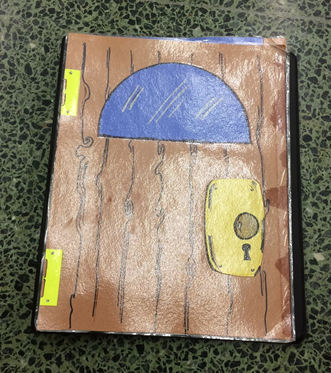
Another visual cue I turn to is my transitions binder. The front cover has a picture of a door. Upon seeing the binder, students begin singing Who’s That Tapping. After singing the song, the binder (door) opens to reveal a picture or other small item that pertains to the next song or activity, and the students automatically launch into the new song.
Literacy Transitions
There is a wide array of transitions to foster the development of music literacy. These transitions make it possible to bridge repertoire while sneaking in a little extra practice of skills. Here are two examples of how to add the element of make-believe.
Example 1:
To use a motivic connection, look for two songs that have a rhythmic or melodic motif in common. Watch the video below demonstrating a transition from Hot Cross Buns to Bow Wow Wow.
Example 2:
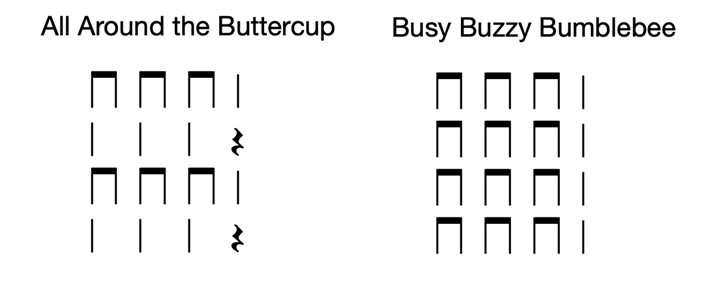
The next video demonstrates a motivic alteration between the songs All Around the Buttercup and Busy Buzzy Bumble Bee. Notice both songs share the same rhythm for phrases 1 and 3, in phrases 2 and 4 of All Around the Buttercup changes to the rhythms of the same phrases for Busy Buzzy Bumblebee.
Aural Cues
Example: Rhythmic and melodic patterns can act as transitions. If you have recurring transitions, such as making a circle, making a line, and instrument set up. Assign a different rhythmic or melodic pattern to each. To avoid students transitioning to various activities every time they hear a rhythmic or melodic pattern, designate one instrument for each aural transition.
How to Begin
With so many options, planning transitions can feel like a daunting task. The first step is to incorporate your transitions after you have planned your core lesson. Begin with directive transitions. Analyze your lesson for sections you would normally speak set of directions and, instead, write new lyrics to the song from that section. After building comfort using directive transitions, practice embedding thematic transitions. If you’ve studied the Kodály concept, break out that retrieval system and folk song collection, and begin hunting for connections. If there is a song about “stars,” find other “star” songs, or “night,” “dreams,” “moon,” etc. Thematic connections are especially easy to find in the repertoire for younger students.
Lastly, delve into literacy transitions. Search for songs that contain the same motif or similar motifs to act as the pivot between the two songs. Or, have the phrases of only one song written on flashcards and displayed out of order. Students read the unordered flashcards, decipher the song, and arrange the cards to their correct order. Through all of your transitions planning, be creative!
Putting it All Together
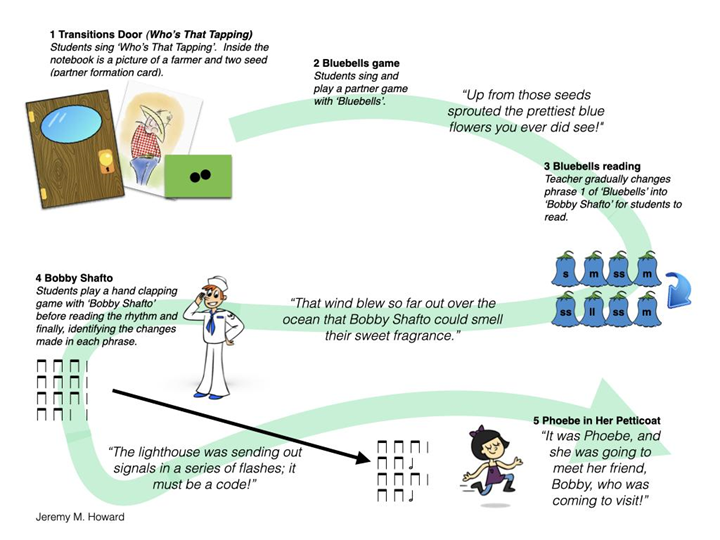
The picture below illustrates a mini-lesson with various transitions. Take note, not only the assortment of musical activities, but also the rotation between music for joy, and concentrated building of musical skills.
Every action we take is a sequential step with thoughtful planning to ensure we arrive at our destination. Not only do we want to arrive at the destination, but we want to make it an enjoyable ride, exploring all there is to explore along the way. The outcome will be a rewarding teaching experience that will have your students anticipating and predicting where they’re headed next. Now, embark on a journey with your naturally creative, curious students. By playing to students’ affective domain through characters and storylines they care about, they will internalize repertoire faster, develop critical thinking and prediction skills, retain musical content, and, best of all, want to come back for the next adventure.
References
Brumfield, Susan. (2014). First, we sing! : Kodály-inspired teaching for the music classroom. Teaching guide. Hal Leonard Corporation.
Note: This article was originally published by Music ConstructED on October 12, 2020.
Jeremy Howard received a BME in vocal music education and an MM with an emphasis in the Kodály philosophy from Morehead State University and is a certified Kodály educator. Additionally, he studied at the Kodály Institute in Kecskemet, Hungary. Mr. Howard serves as the 3 Year-Old through 8th Grade…





 Facebook
 Twitter
 Pinterest
 LinkedIn
 Email
Email Print
Print