Music by Women is a new resource that provides classroom materials centered around women composers and their works. Including music written by women in our teaching is a small (but critical) piece of the puzzle in our work to create more inclusive, representative, socially just music classrooms.
My first three years of teaching were all but “typical.” I was offered the chance to join an elementary school partway through the year during my student teaching, and I jumped at the opportunity. The first three months were an absolute blast, but then March 2020 hit, and the harsh reality of a global pandemic started to sink in. I finished the rest of the 2019-2020 school year remotely.
The following year, I was at a different school in the district with 500 new students and taught through 4 different learning models, as did so many others, and it was more exhausting than I could have imagined. In my third year, I started in a new school in a new district with 550 new students; I taught a new grade level and started a musical theater program. Through all the changes and newness of my first three years of teaching, one thing remained constant: a set of “Great Composer” posters, probably hanging in the same place for at least a decade, were ready to welcome me to a new classroom. Despite being from different sources and hung in different schools, I’m sure you can guess what each of these portraits had in common… They only featured dead white men.
Ibet if I asked any gathering of music teachers to name 20 composers, it would hardly be a challenge. What if, though, I stipulated that 2 of those 20 composers must be women? I’d guess that names such as Fanny Mendelssohn Hensel, Clara Schumann, and Amy Beach might appear on the list. Women make up 51.1 percent of the population in the United States (Statista, 2021). With that in mind, what if instead of asking that 10 percent of composers be women, I asked for 50 percent—to mirror the ratio of men to women in the US population? Would that same group of musical experts be up for the challenge?
Why Teach About Women Composers?
It seems a common belief that there is no quality classical music written by women — especially not in the styles and genres we value enough to include in our curriculum. For teachers, this notion is usually introduced in the elementary music classroom at a young age, perpetuated throughout K-12 education, and then upheld by the canon taught in music theory, music history, and methods courses in undergrad. This belief often stems from the music taught to them and the images surrounding them for our students.
Women have always composed, but their talent, insight, depth, and mastery have been overlooked. Historically, classical music hasn’t been the most welcoming field for women. Over 30 years ago, Emily Style introduced her “window and mirror” metaphor which helped teachers see that students need to see both others AND themselves in the curriculum and the classroom (Style, 1996). In a classroom that does not highlight music by women, 50 percent of students are failing to see themselves in the curriculum to see that they too can share their music with the world.
We have the opportunity; we have the resources; we have the expertise. Now we must actively work to question and disrupt the gender imbalance in the composers we value, study, and whose music we teach.
Introducing Music by Women
Music by Women(formerly Music Theory Examples by Women) is a non-profit founded in 2017 by Molly Murdock and Ben Parsell and newly relaunched in 2022. Our work strives to elevate women composers and theorists by advocating for the study and performance of their works and providing high-quality, easily accessible resources that bring light to their often-overshadowed contributions. Music by Women provides classroom materials for teachers at the elementary and middle school levels (and up to the collegiate level) to teach various concepts with one crucial distinction—they center around women composers and their works.
Continue reading for resources and teaching ideas that can be readily incorporated into a general music curriculum to highlight the contributions of women composers.
Biographies
Music by Women – Composers: The site provides profiles of composers ranging from before the Medieval era to the modern day. The profiles include quick facts like birth/death dates and nationality, a concise biography, a list of resources to learn more about them, and playlists of their most notable works.
Teaching Idea: Use these biographies to teach students about a female counterpart to each male composer. If you teach Madrigals and Claudio Monteverdi, also teach about Vittoria Aleotti! Are you teaching about Pete Seeger and his contributions to the folk revival? Then also teach about Ruth Crawford Seeger, his step-mother, and Elizabeth “Libba” Cotton, who worked for his family!
Posters
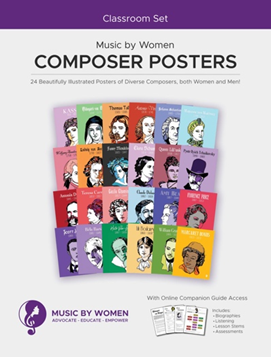
The Classroom Poster Set: In collaboration with an artist and musician from England, Music by Women has created a poster collection featuring images of women composers. The Classroom Set is a more inclusive collection of 24 composers from the Medieval era to the 21st Century, including women, people of color, and men in a matching set. Between all of our poster sets, we have 34 different composers.
Use these posters to show your students the diversity in the field. Women have been writing music for centuries, and these posters give a broad representation of that fact. An Online Companion is included that provides some of the following digital content for each of the composers: biographies, lesson stems, suggested listening lists, quick facts about the composer, quizzes with multiple-choice and true/false questions, activities (word search, crossword, guided notes, listening maps), and links to more resources for further learning.
Teaching Idea: These beautiful posters can be used for bulletin boards, class discussions, listening lessons, composer of the month features, composition activities, and more!
Listening
Music Playlists: As a significant component of the Respond and Connect strand of the 2014 Music Standards published by the National Association for Music Education (2021), listening is a staple of the general music classroom. Teachers often include listening activities to art music by Copland, Saint-Saëns, Vivaldi, Mozart, Beethoven, Bach, Greig, and Chopin. Do we similarly jump at the chance to teach a listening lesson incorporating a piece of art music written by a woman? Music by Women has extensive playlists sorted by concept, composer, instrument, genre, and era to help teachers include music written by women into their curriculum.
Teaching Idea: Throughout the year, I work in kindergarten and first grade on keeping the beat in both simple and compound meters. Developing competencies in maintaining the beat in groups of 2 (simple meter) and 3 (compound meter) can be done with music written by women and men!
In my classroom, we begin with teacher-initiated non-locomotor beat motions working towards locomotor and then transition to incorporating more student-initiated beat motions. Use these two playlists to find pieces of music in simple and compound meters:
I share our music composer’s name, gender, and nationality in the younger grades. In older grades, because we have already had discussions about “feminine” and “masculine” qualities of music, I like to have students guess the gender of the composer anytime we are listening.
Lesson Plans & Activities
There are lesson plans, and activities in the Online Companion Guide included with your purchase of the Women Composer Posters. These lesson plans are geared toward the general music classroom. There are lessons based on composers, specific concepts such as comparatives, expression, rhythm, melody, harmony, and form. In addition, more free lesson ideas and outlines are being posted.
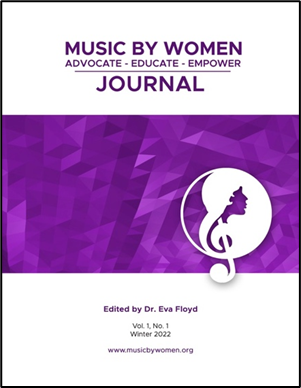
The Music by Women Journal is an exciting new resource designed to promote the contributions of women in music and share a variety of relevant content. All musicians will find meaningful content to spark curiosity, gain new knowledge, and incorporate it into the classroom. Articles, reviews, lesson plans, score studies, and opinion pieces help broaden understanding about women’s contributions to our shared artistic experiences. With contributing authors who are experts in their field, we are excited to share their expertise with readers. New issues will be published throughout the year.
Teaching Idea: Use articles in the Journal to educate yourself about women’s contributions to music. Teachers are life-long learners, and this is a great resource to learn more about women in music. The first issue, “Getting to Know You,” features an article about Satis N. Coleman, an innovative music educator working in the first half of the twentieth century, written by Jessica Steuver.
Other Resources
Music by Women has many other wonderful and exciting resources available on our newly launched site, with even more material on the way. Suppose there are other resources you are interested in regarding women in music. In that case, we have a growing list with links to databases of composers, lists of music, podcasts, and organizations and societies with missions similar to ours.
Call to Action
Diversity, Equity, and Inclusion work are finally headed toward the forefront of music education, and frankly, it is about time. Teaching music written by women is a small (but critical) piece of the puzzle in our work to create a more inclusive, representative, socially just music classroom. We cannot change that men have historically had more opportunities for representation in music. Still, we can change the future by programming and teaching about music by women, people of color, and members of the LGBTQ+ community in our classrooms.
More composers and more resources are constantly being added, so browse the site often, and follow us on social media for updates!
National Association for Music Education. (2021, April 1). 2014 Music Standards. NAfME. Retrieved March 1, 2022, from https://nafme.org/my-classroom/standards/core-music-standards/
Statista. (2021, September 10). Total population of the United States by gender 2010–2025. Retrieved March 1, 2022, from https://www.statista.com/statistics/737923/us-population-by-gender/
Style, E. (1996). Curriculum As Window and Mirror. Social Science Record.
Ben is the vocal music teacher at Alice Smith Elementary School in Hopkins, MN, where he teaches K-6 general music and musical theater. He serves as the Director of Youth Choirs at Mount Olive Lutheran Church, West Campus, and…






 Facebook
 Twitter
 Pinterest
 LinkedIn
 Email
Email Print
Print