This year, students are still going to need music and make music. As musicians and music teachers / directors, we always improvise … and the current situation will force us to make the improvisations of a lifetime. This year asks us to think outside the box and our comfortable safety net. Remember to take care of yourself. Keep in touch with your kids with a smile, wave, and air hug. And………wear your mask.
I don’t have to tell you that your teaching lives are going to be different for the unforeseeable future. Teachers are unsure of how social distancing is going to work in their classrooms. How do we use instruments? Can we sing? What about dance and movement?
All of this means that you might have to throw out everything you learned in a music methods class, or at least, reconfigure it outside the box. However, if you have training in either Orff Schulwerk and/or Kodály, you actually have reliable processes and structures to help you plan for your school year.
Kodály
In the Kodály approach, the teaching procedures are broken down into the preparation phase, the presentation phase, and the practice phase (Eisen & Robertson, 2010). Concepts are prepared with three learning styles: physical, aural, and visual. These can be broken down further into the following skill areas for practice: solos, reading, writing, improvisation, inner hearing (audiation), listening, form development, movement, part work, and instrument use. The approaches that will require the most adaptations involve physical assessments. The sequencing, however, gives the teacher a structure and framework for developing new strategies.
Orff
The Orff philosophy focuses on “elemental” music, or music based on the natural rhythm, movement, and play of humans, developed through an improvisational process (Orff, 1976; Wang, 2013). The Orff process is basically scaffolding: play, imitation (echoing), exploration, improvisation. The beauty of Orff Schulwerk is the “permission” to change things up.
Now, with these basic outlines of both philosophies listed, let’s see how we can approach them in a new classroom environment.
Movement-Used in both Kodály and Orff
Creative Movement:
This year would be an excellent opportunity to focus on non-locomotor movement, especially with utilizing fine motor skills in the fingers (flicking, wiggling, etc.), arms, legs, and head. To keep youngsters in their spots, put a tape “X” on the floor. (You COULD use hula hoops, but be prepared to wipe them down between classes.)
Your kids will want to move. Make sure to use action words to give them movement “bell ringers.”
Do not utilize props such as scarves, which are difficult to launder properly. Consider remnant hose from Hanes, paper plates that can be disposed of, or neckties from home. You can ask for donations of ties, but obviously, they will need to be laundered thoroughly before donating them to kids.
Recorded Non-Locomotor Movement:
Children’s songs that focus on JUST moving hands, fingers, legs, feet, or movement in one spot can become annual favorites. One song my students loved year after year (even up to fourth grade!) was “One Green Jelly Bean” by Lee and Sandy Paley, found in Movement Songs Children Love. It involves tummy rubbing, head patting, jumping, and knee kicking, which takes quite a bit of focus!
Brain Dance:
Even before the novel coronavirus hit, teachers were being made aware of social-emotional learning and students experiencing trauma. We can only imagine what students face now: uncertainty about becoming ill, potential family members getting sick, problems at home.
Tapping is one technique recommended by counselors to help students calm themselves. It is incorporated, along with other strategies, into a practice called Brain Dance, developed by Anne Green Gilbert. Much of this practice focuses on non-locomotor, fine motor, and midline-crossing activities, which contribute to focus and anger management, among other physical and emotional issues.
Folk songs:
Unless you get to teach music in the gym or have a very large room, longways sets and circle dances will probably not be good. If you can, here are ideas for modifications (and they will take a lot of prep time):
Take students outside, if possible.
Modify your longways sets so that if students are to meet in the middle, they are still 6 feet apart, then mark those spots.
Ask the students what they would suggest instead of a cast-off or bridge. They are often much better about thinking outside the box than we are.
Find songs that don’t really NEED to be in a circle. For example, eliminate the circle in Seven Jumps and ask the students to create non-locomotive moves. They can still do the kneel, etc., during the fermatas. Other adaptable dances ideas:
Head and Shoulders (Baby) from Jump Jim Joe/Sashay the Donut
“When I Was a Baby,” from Jump Jim Joe/Sashay the Donut
“Little Johnny Brown,” from Jump Jim Joe/Sashay the Donut or Step It Down. Use individual handkerchiefs in baggies. If a student is picked, they get a clean handkerchief from an unopened baggie.
“Everyone Keep the Beat,” from Movement in a Steady Beat.
“Monster, Monster, Monster Man,” from Movement in a Steady Beat. Adaptation Idea: Change locomotor movements to non-locomotor.
Kodály Preparation
The singing aspect of Kodály is going to be difficult, and the jury is still out on what constitutes “safe” singing, if anything. Check with the updated suggested procedures with the American Choral Directors Association if you are unsure about the latest research in safe singing. The suggestions below that incorporate singing should involve distancing and a mask, preferably.
Visual:This is probably the easiest to accomplish with an interactive whiteboard. However, you will need to consider that students with visual disabilities will no longer get to sit closer to the board and may or may not have a paraprofessional near them. Make extra visuals in Google slides for those students or students who need to hold something if they have 1:1 devices. Otherwise, make the visual and laminate it, so it is easily cleaned, or use an Interactive whiteboard. Do not allow students to use the board.
Aural: Use a microphone/small sound system if possible if you are in a large room with distancing to make sure you can be heard.
Physical:Apply ideas from the movement section and use non-locomotor ideas.
Kodály Practice
Reading: Use an interactive whiteboard. If you would like to share student work, create an activity in SeeSaw or find one in the Activities Library. Display on the whiteboard for students to read.
Writing: The safest way to do this and assess without the need to walk around would be using the “Seesaw” online portfolio. You can see, grade, and comment on completed activities submitted in real-time.
Audiation:Incorporate self-space movement when the concept is heard. Use the manipulatives to create new melodic patterns or rhythm patterns and record in SeeSaw. Record yourself singing part of a melody and ask them to record themselves singing the rest in SeeSaw.
Improvisation: Ask students to bring their own manipulatives in a baggy. The students can create with the manipulatives suited rhythm, melody, or form and take a picture through SeeSaw. They can also make a video.
Partwork: Students could potentially work with partners, keeping a distance. However, this could be confusing with a whole class. One option is using the Acapella app if devices support it. The students would not have to project as loudly to make sure their partners can hear them, and the videos can be saved and uploaded to SeeSaw for assessment.
Orff Applications
Instruments:
Using instrumentswhile maintaining cleanliness is most likely one of the greatest concerns for Orff as well as Kodály practitioners. As some teachers may opt to not use instruments, some will want to continue to do so. It is excellent for improvisation and note reading.
Recorder: If you choose to play recorders, probably the best way is on a rotation basis, so there are not as many aerosol particles. One day, half the class works on recorder assignments or uses recorder as Kodály practice, and the others do other activities. When students are ready, they can record themselves into SeeSaw. Switch the next day. Do not use school recorders until you send a letter home telling parents how they will be cleaned. If you have students on free or reduced lunch, utilize organizations such as United Way or parents’ groups. When I ordered recorders, I would include a line for parents to check to indicate they would be willing to donate money to buy a recorder for another child. Do not allow them to take recorders home, but ask them to keep them in their classroom cubbies instead.
Mallet instruments / other percussion: This is another situation where you cannot rotate instruments. These must be assigned. For auxiliary instruments, consider personal instrument kits. Each student will have their own set with their name on all the pieces and could be responsible for wiping them down. You could also add any personal movement props to the kit if there is room in the bag. Utilize body percussion whenever possible.
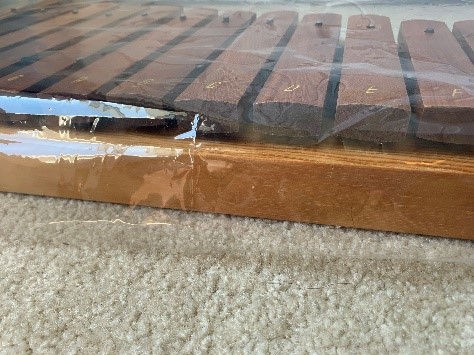
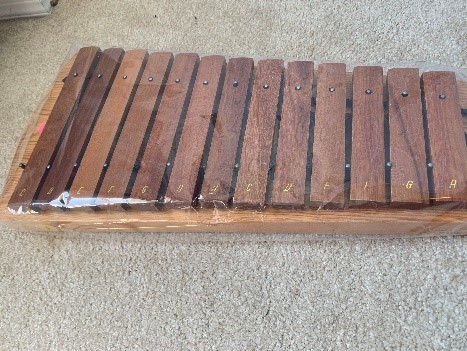
Pitched mallet instruments are of particular concern. The teacher, not the students, should always remove the bars. Randi Shanker, who teaches in a St. Louis County district, posted an idea on Facebook for covering the bars with a clear shower curtain. This would be much easier to wipe down with disinfectant wipes. Also, consider asking students to wear gloves. These gloves can also be kept in their music kit.
Ukulele: Like everything else, do not let students share ukuleles if you do not have a full class set. If you are looking to purchase or add to your ukulele inventory, consider Kala Waterman ukes, which are constructed with polycarbonate and will take being cleaned with a disinfectant much easier.
In general regards to instruments, band and general music teacher Ashley Pond recently shared this database of resources on instrument care and advice during COVID. Additionally, West Music has provided a source for instructions on how to safely sanitize instruments.
References Cited:
Amidon, P., Amidon, M. A., & New England Dancing Masters Productions. (1991). Jump Jim Joe: Great singing games for children. Brattleboro, Vt: New England Dancing Masters Productions.
Chappelle, E., Gilbert, A. G., & Ravenna Ventures, Inc. (2007). Brain dance music. [CD]. Seattle, Wash: Ravenna Ventures, Inc.
Chappelle, E., & Ravenna Ventures, Inc. (1993). Music for creative dance: Vol 1-5. [CD]. Seattle, WA: Ravenna Ventures, Inc.
Eisen, A., & Robertson, L. (2010). An American methodology: An inclusive approach to musical literacy. Lake Charles, LA: Sneaky Snake Publications.
Gagné, D. (2008). Movement songs children love. Red Deer, Alta: Themes & Variations.
Gilbert, A. G., Houck, B., & Gilbert, A. G. (2019). Brain-compatible dance education.
Jones, B. (1988). Step it down. Cambridge, Mass: Rounder Records.
Orff, C., & Murray, M. (1978). The Schulwerk. New York: Schott Music Corp.
Wang, C. C. (2013) Why Orff-Schulwerk? In Wang, C. C., & In Springer, D. G. (2013). Orff Schulwerk: Reflections and directions: proceedings of the symposium Global Connections in Orff Schulwerk: Reflections from Kentucky.
Weikart, P. S., & Boardman, B. (1990). Movement in steady beat: Activities for children ages 3-7. Ypsilanti, Mich: High/Scope Press.
Karen Stafford is a retired elementary music specialist, church music director, Teachers Pay Teachers seller, and adjunct professor from Union, Missouri. Dr. Stafford obtained her BME and MA from the University of Central Missouri and her Ph.D. from the…




 Facebook
 Twitter
 Pinterest
 LinkedIn
 Email
Email Print
Print