One of the best ways to celebrate the contributions of any culture or holiday of significance is to explore the musical traditions that are associated with or attributed to that specific celebration. When it comes to honoring the traditional artistic contributions of the Hispanic people, one has to look no further than the beautiful and vibrant music of the mariachi genre.
Why do we celebrate the Hispanic community in the United States?
As of August 2019, there are 59.9 million Hispanics in the United States, or 18.3 percent of the country’s population. According to the Hispanic Center at the Smithsonian, Hispanics have fought in every war since the American Revolution and continue to advance communities across the country as small business owners, veterans, teachers, and public servants, among many other professions. Hispanic Heritage Month, observed from September 15 to October 15, allows us to recognize these achievements and the contributions made to our national story by so many.
One of the best ways to celebrate the contributions of any culture or holiday of significance is to explore the musical traditions that are associated with or attributed to that specific celebration. When it comes to honoring the traditional artistic contributions of the Hispanic people, one has to look no further than the beautiful and vibrant music of the mariachi genre. UNESCO declared mariachi as an Intangible Cultural Heritage of the Humanity during the sixth reunion of the Intergovernmental Committee for the Safeguarding of Intangible Heritage. It received the unanimous vote of the 24 countries that participate. With this declaration, Mexico has seven cultural manifestations inscribed on the list of the United Nations Educational, Scientific, and Cultural Organization (UNESCO).
According to world-famous mariachi performing artist and composer, Jose Hernández, mariachi evolved from the small towns and ranches of the western region of Mexico into what is immediately recognized today across the world as a symbol of Mexican culture.
Hernández saw mariachi music’s social value increase dramatically among Mexican Americans when popular singer Linda Ronstadt, of Mexican-American background, launched her album, Canciones de Mi Padre, in 1987. She made it “cool” to like mariachi music; thus, it became worthy of the American popular mainstream and not simply “my grandma’s music” (Sheehy, 2006).
Why Teach Mariachi
In the 2010 Census Brief, several relevant findings articulated why mariachi, instead of other forms of Latin music, would be an appropriate choice to introduce into the school curriculum. From 2000 to 2010, the percentage of the population that self-identified as Hispanic or Latino grew from 35.3 million to 50.5 million. Of those who self-identified as Hispanic or Latino, it was the Mexican population that accounted for approximately three-quarters of the 15.2 million increase during this same period. The vast majority (63%) of Latinos in the United States are thus of Mexican descent with a median age of 27. This is considerably younger than 37 years of age, which is the median age of the general U.S. population. Thus, the increased likelihood of child-bearing could account for some of the increase of school-aged children of Mexican descent. (Albert, Ennis, & Rio-Vargas, 2011)
With 69% of current Latino students identified as being of Mexican origin and with growth indicators estimating an increase of 166% in this sub-group by 2050, it follows that local education agencies could engage these children by recognizing and honoring their cultural traditions. (Neel, 2017, p.3)
Thus mariachi, a form of folk music, is immediately identified as a national symbol encompassing the essence of Mexico and considered the most impactful component of the arts education program when providing a curriculum that embraces culturally responsive and relevant teaching. (ibid.)
Mariachi and the Core Music Standards
A growing number of school districts have developed a standards-based curricular approach to teaching mariachi built on all four of the artistic processes of Creating (Cr), Performing (Pr), Responding (Re), and Connecting (Cn).
Below is an example of how each of these processes uses the mariachi song in Ranchera (from the ranch/country) Valseada style, defined as a simple, two-part song (Ex: Cielito Lindo) in 3/4 time delivered by a soloist in an extroverted style. (The Ranchera Lenta style is similar except in 4/4 time and sung in a deliberate, highly-emotional style often expressing sadness over lost love and even including sob-sounding, crying gritos [yells] as part of the performance.)
Instructional Goal
To recognize form in simple mariachi performance styles. 1.1 The student will identify a song in the Ranchera Valseada style.
Assessment Activity 1 | Cr
Ask students to choose a topic that describes their locale (i.e., the mountains, lakes, stars—their “country”) to sing about and compose a simple song in the style of the Ranchera Valseada using a provided I, IV, V chord progression in any given key.
Assessment Activity 2 | Pr
Have students perform one of their own compositions or a provided selection representative of the Ranchera Valseada style and ask them to identify the appropriate characteristic elements (text subject, 3/4 time)
Assessment Activity 3 | Re, plus Technology
Have students listen to or view on YouTube at least three different performances of the same Ranchera Valseada (Ex: Cielito Lindo), then describe the various differences/nuances in the performances using appropriate terminology. Ask students to choose their favorite performance from among those observed then provide the reason for their choice.
Assessment Activity 4 | Cn
Have students explain—either in writing or using essential questions—the origin of the Ranchera Valseada style, the characteristic elements of the style and its significance in the mariachi genre.
(Rachel Spacek/Las Vegas Review-Journal)
Embracing Mariachi Education Through Policy
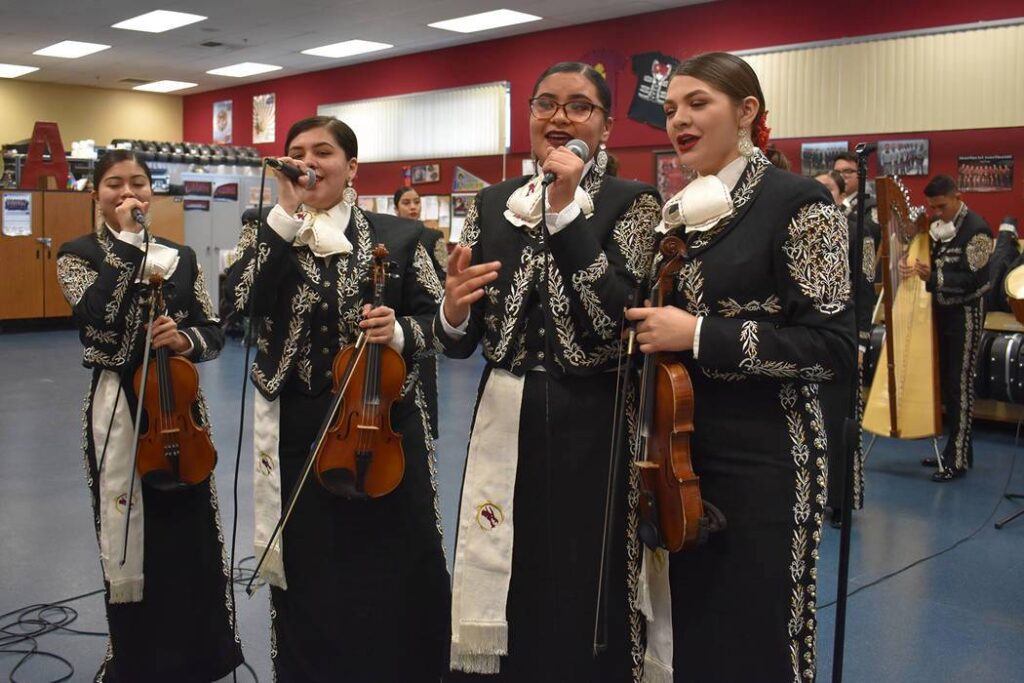
Headquartered in Las Vegas, NV, the Clark County School District’s (CCSD) comprehensive Mariachi Education Program has become the nation’s largest with approximately 6,000 middle and high students taking mariachi classes daily during the 2019-20 school year. In the formative years, district and community leaders who envisioned a program that would eventually serve the cultural needs of the CCSD’s growing population of Hispanic students worked together using a longitudinal approach rooted in a well-thought-out design to lay the groundwork strategically.
Exploring the various program components allowed formal articulation for the creation of the program. The exploration additionally answered questions such as: how will the program be implemented, what financial support will the district provide, how can we forge community partnerships, and what achievements can we expect?
Established in the fall of 2002, the CCSD chose to implement the mariachi program side-by-side with the existing instrumental and vocal curriculum already made available during the school day. This was significant because offering the course through the policies already established for the more traditional music course offerings, the district affirmed that the comprehensive, standards-based, sequential mariachi curriculum contained the same academic rigor as other courses of study in music. The district thus put its full support and resources behind the Secondary Mariachi Education Program.
As was anticipated, the implementation of the mariachi program resulted in positive breakthroughs in several areas. The program indeed met the goal of engaging increased numbers of Hispanic students. The program has grown nearly 25-fold since its inception in the 2002–2003 school year. CCSD mariachi educators report that their students demonstrate a high rate of school attendance because they simply do not want to miss out on the enjoyment of music-making each day. This has resulted in students attending all of their classes more regularly, thus leading to increased levels of achievement by nature of the fact that they are attending school more often. In the case of the CCSD, most mariachi educators also have self- imposed performance expectations that require a specific GPA for students to perform. This stipulation has also resulted in significant academic gains for participating students.
The district’s mariachi educators also report that their programs experience a high level of retention over the long term, thus leading to the vast majority of participating students eventually graduating from high school on time. One high school principal fully credits the 20-percentage point gain in graduation rates to the mariachi program.
Although they may not have at first recognized how the mariachi program might engage Hispanic students and their families so significantly, administrators soon discovered how music in a bilingual setting could expedite English language acquisition skills. CCSD principals soon reported an increase in the involvement of the Hispanic parents and other family members, including siblings of participants who enroll in the same school as their performing brothers and sisters. Entire extended families attend concerts, even singing along with the students during the performances and making traditional food to sell at the concert events to fundraise. Principals also reported that this increased activity continues to target the vision of helping parents, families, and the local business and residential community to view the school as more relevant and culturally friendly.
Finding Resources
As one might imagine, resources for teaching standards-based mariachi courses for credit were non-existent in those early years, so the mariachi educators had to write their own. Since then, districts across the country have adopted the Simplemente Mariachi method as the resource for beginning level mariachi ensemble programs.
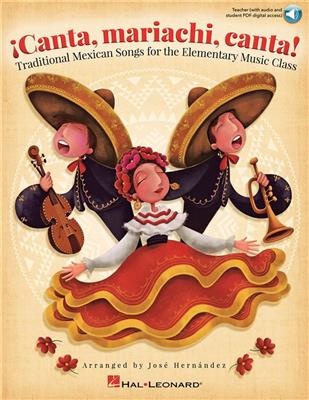
HOWEVER, the very best resource available to teach traditional mariachi songs for elementary programs at any time of the year is ¡Canta, mariachi, canta! Traditional Méxican Songs for the Elementary Music Class published by Hal Leonard.
The material presented in ¡Canta, mariachi, canta! provides our younger students to experience authentic mariachi styles and rhythms through their chorus or general music classes. Eight traditional Mexican songs will transport the students to a place rich with recognizable melodies (including La Llorona, popularized in the movie, Coco) and easy-to-learn harmonies. The arrangements by world-renowned mariachi composer and performer, José Hernández, work well with piano or guitar accompaniment. You can even add pitched Orff instruments for even more fun!
This collection offers vocal parts with Spanish lyrics, piano and guitar accompaniment, Orff parts, brief song translations, and history. It also includes digital access to authentic recordings produced by Maestro Hernández with age-appropriate vocals as well as professionally recorded accompaniments performed by famed Mariachi Sol de Mexico, on traditional mariachi instruments for added authenticity! Students can model the singing and perform with the full-sounding accompaniment recordings. Each book contains a code students can use to gain on-demand, permanent digital access to the Hal Leonard site where teachers can download PDFs of vocal and instrumental (including Orff) parts and the recordings.
Hernández has written that mariachi music has evolved from the small towns and ranches of the western region of Mexico into what is immediately recognized today across the world as a symbol of Mexican culture. He wrote !Canta, mariachi canta¡ to help younger students connect with many songs from the great Mexican songbook. The selections chosen have had a significant impact on generations of families. They are meaningful because they are timeless classics that have been used, and continue to be used, to commemorate and celebrate momentous events.
Songs includeCielito lindo, El venadito, La golondrina, La llorona, La sandunga, Las mañanitas, Los barandales del puente, and a beautiful arrangement of Noche de paz (Silent Night) for the holidays featuring both English and Spanish lyrics.
Ennis, S. R., Ríos-Vargas, M., & Albert, N. G. (2011). The Hispanic population: 2010. Washington, D.C.: U.S. Dept. of Commerce, Economics and Statistics Administration, U.S. Census Bureau.
Neel, Marcia MacCagno (2017) Mariachi and Spanish speaking English learners: District initiatives, models, and education policy, Arts Education Policy Review, 118:4, 208-219, DOI: 10.1080/10632913.2017.1291457
Marcia served as the Supervisor of the Secondary Music Education Program of the Clark County School District (CCSD), headquartered in Las Vegas, Nevada, from 1994 through 2007. Highly regarded for her commitment to program expansion and innovation, Marcia is…





 Facebook
 Twitter
 Pinterest
 LinkedIn
 Email
Email Print
Print