SUMMARY
Discover ideas on how to overcome adolescents’ reluctance to sing. Gamification can motivate students in your music classes.
by Karen Stafford





Discover ideas on how to overcome adolescents’ reluctance to sing. Gamification can motivate students in your music classes.
by Karen Stafford
Teaching singing to adolescents has become a considerable frustration. It was challenging getting the males in my upper elementary classes to take singing seriously or to sing, period. I realized that I needed to make things competitive.
Nagging didn’t work. Ignoring student behavior was ineffective. Proximity while singing in their ears did not prompt any change.
I needed to change my approaches. My goal was to pass ownership of musicality to the students. I believed that once they felt ownership, classroom management would improve. It did!
Football was a very popular sport in my district, with many of my fifth- and sixth-grade boys participating in a junior league. I designed a Vocal Football bulletin board as an incentive to encourage singing by my students.
Each student initialed a little paper jersey, and I kept them in envelopes with students’ classroom teachers’ names. Here is how I structured the game.
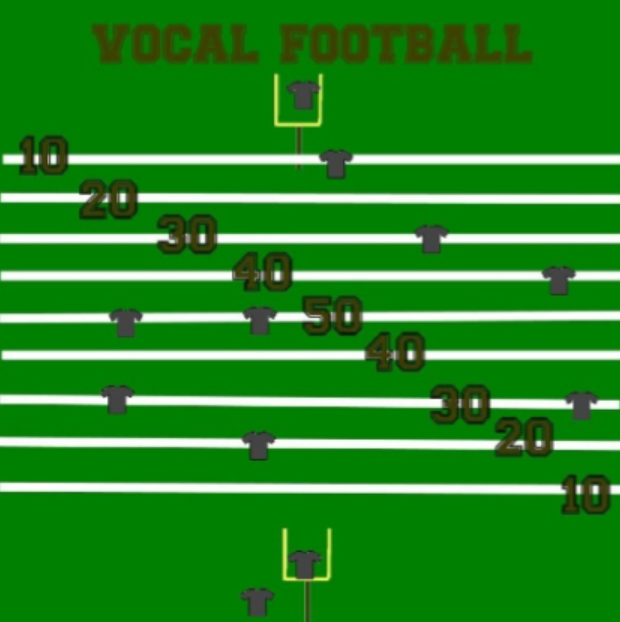
Full discloser: this was not immediately successful. Usually, a brave boy would go first. If he succeeded, I had a gaggle of boys volunteering. The girls didn’t act like a “gaggle,” but they would shyly raise their hands.
The kids chose whether they would sing in front of the class or come up to me. I only chose 2-4 during class, depending on what we needed to accomplish or how they behaved. If you are interested in trying this game in your classroom, it is available at my Teachers Pay Teachers store: Vocal Football Bulletin Board
To play “Solfege Shuffle,” you will need the colored floor discs from P.E. supply stores or make and laminate your own.
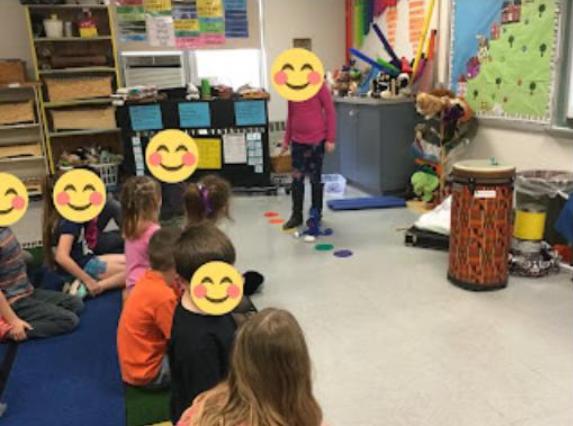
In the picture, a younger group of students are playing the game using the pentatonic scale. The picture does NOT show the discs vertically, and that was a mistake I made. Displaying the dots vertically helps students better grasp the concept of descending and ascending. This game is also available in my Teachers Pay Teachers store: Solfege Shuffle
Some teachers use a skein of yarn to encourage class discussion. I adapted this teaching approach to encourage singing.
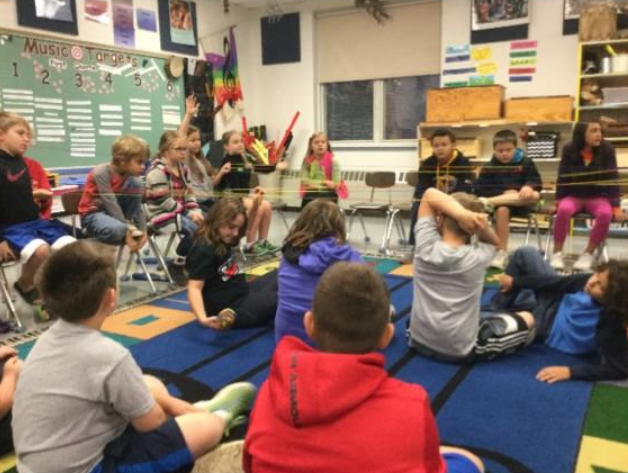
The traditional version of the game involves the teacher starting a discussion and then tossing a ball of yarn to a student, continuing the story. Meanwhile, the teacher holds onto the end of the yarn. This pattern continues, with each person holding onto a yarn section before tossing the ball to a different student. This tossing of yarn around the room creates a spiderweb.
Students sing one solfege syllable on a major scale and then toss the yarn to another student to sing the second pitch. If the students weren’t quite on the pitch, a few students would sing along to help their peers match the correct pitch.
Assigning students jobs for performances increases student ownership. Assign one student to be the listener. The listener reports what they hear during a rehearsal and provide constructive criticism. This provides insight into what your students understand about the music and performance expectations.
Exit tickets also provide excellent insight into student learning. Students can summarize what they did well and where they believe improvement is needed. Seesaw is an online portfolio platform that is an excellent way to save student information.
When I first started working with students in early adolescence, I was terrified. However, once I learned to embrace their quirks and identified ways to navigate the musical issues of pre-teens, I fell in love with my fifth and sixth graders. The same is true for seventh- and eighth-grade students. Finding whys to accommodate students’ singing reluctance and ways to make them feel more comfortable changed my teaching for the better.
Cooksey, J.M. (1999). Working with adolescent voices. Concordia Publishing House.
Hernandez, D. (n.d.). Why are more children going through puberty at a younger age? Texas A&M Today. https://today.tamu.edu/2018/01/11/why-are-more-children-going-through-puberty-at-a-younger-age/
Huff-Gackle, L. (1985). The young adolescent female voices (ages 11-15): Classification, placement, and development of tone. The Choral Journal, (25), 8, 15-18. https://www.jstor.org/stable/23546818.
Killian, J. (1999). A description of vocal maturation among fifth- and sixth-grade boys. Journal of Research in Music Education. (47)4, 357-369

Contributor
Karen Stafford is a retired elementary music specialist, church music director, Teachers Pay Teachers seller, and adjunct professor from Union, Missouri. Dr. Stafford obtained her BME and MA from the University of Central Missouri and her Ph.D. from the…
Discover more from Karen Facebook
 Twitter
 Pinterest
 LinkedIn
 Email
Email Print
Print