Discover a new way to teach your students to read music! Standard notation does not always click for students. Introducing iconic notation, which can be color-coded to show note duration and pitch relation, might solve this dilemma.
by Brittany Bauman
On-Demand PD
This Pedagogical Perspectives focuses on how to introduce iconic notation, examples of different types of iconic notation systems, ways iconic notation can be used, and how to transition students to standard notation at an appropriate time.
What is the purpose of iconic notation? It took me many years as an elementary music educator to answer that question for myself. My first teaching job was K-5 general music.
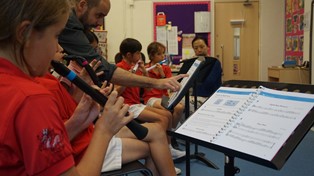
My third graders started on the recorder and did not yet know how to read standard notation. For the first few weeks, I taught the recorder entirely by ear. I encouraged students to sing and improvise as often as possible. These activities provided a solid musical foundation, and students were progressing well with their instrumental skills.
When I started introducing standard notation, half the students got it right away, and the other half struggled. Standard notation didn’t click easily for some students despite my best efforts. I then started searching for an iconic notation system but wasn’t completely satisfied with any existing ones.
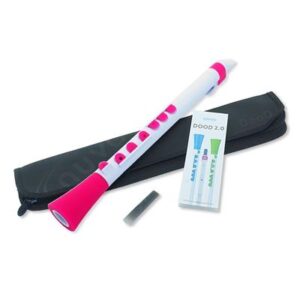
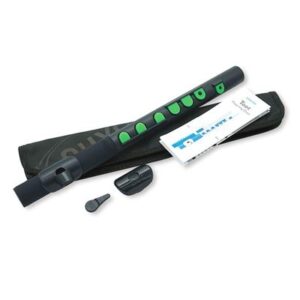
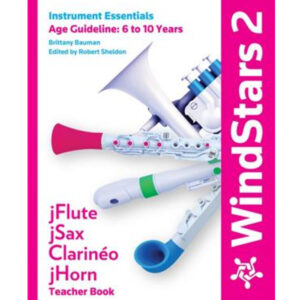
A few years ago, I had the opportunity to join a team of educators to help create the first pre-band curriculum called WindStars. Like the NUVO Dood or Toot, teachers use pre-band instruments to help younger students learn a wind instrument.
Typically, these students do not read standard music notation. After much deliberation, I created a new iconic notation system. Here is a sample of the iconic notation from the WindStars 1 curriculum:
As an educator, I value that the notation system shows both the note duration and pitch relation. The colors and icons help young students quickly identify notes and engage with reading music right away.
After students are comfortable reading iconic notation, I start to show iconic and standard notation side by side. Seeing both systems together makes reading the standard notation less overwhelming, introducing only one new concept at a time. My students continue to have opportunities to learn by ear and different experiences with reading notation.
Iconic and standard music notation does not have to be either/or. I use both iconic and standard notation overlapping throughout the year with my youngest wind players. I may challenge my older students to read standard notation, but I do not feel a rush to transition my beginners right away.
Through personal experiences and talking with other pre-band teachers across the country, I have found a few strategies that maximize the benefits of iconic notation and eventually make a successful transition to standard notation.
1. Revisit previously learned tunes in new ways.
When a tune is part of my curriculum, it will appear throughout different lessons. Each time we revisit a song, I provide opportunities for my students to engage with it in a new way.
Here are some examples:
Listen while keeping the beat on your body.
Sing the melody on a neutral syllable.
Sing the note pitches while practicing the fingerings on an instrument.
Play the tune on an instrument with a steady beat or backing track.
Play a recording or live performance of the music while reading iconic notation. Identify any symbols that students do not yet know.
Show the iconic notation and standard notation side by side. Ask leading questions to identify what new symbols mean.
Read only the standard notation. Do students understand how the symbols relate to what they hear?
This sequence of learning a tune happens over multiple classes. As students get more comfortable reading notation, challenge them to sight-read new songs.
2. Sing, sing, sing!
I strive to have students sing in every lesson. Singing helps students connect to their instrument (their voice) and helps to reinforce intonation. Once students have heard a tune a few times, encourage them to sing the lyrics or note names.
When transitioning to the instrument, students can sing while moving their fingers. When sight-reading a new tune, give students the first pitch and challenge them to sing the rest of the music independently. Even when reading notation, find opportunities to sing.
3. Don’t abandon rote learning for notation.
Outside of sight-reading activities, teach as many tunes by ear as possible. It can be easy to move away from rote learning as the year progresses.
I try to provide students with opportunities to learn increasingly tricky music by ear and sample from as many different musical styles as I can. Students can usually play something by ear that is rhythmically more complex than the music they can read. Encourage this!
4. Compose.
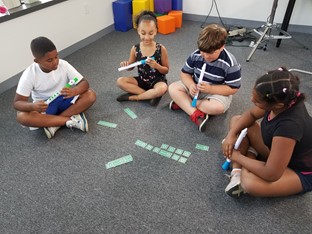
Composition becomes much simpler when introducing the concept using iconic notation. Students can easily organize printed or digital forms of iconic notation to create their own ideas.
Initially, limit the number of notes and rhythms available. Add more note and rhythmic options each time your students compose. Record student performances so they can see their progress throughout the year.
Iconic and standard music notation both serve a purpose. I view iconic notation as one of many available tools we use to pre-teach reading. When paired with aural experiences, iconic notation can be a powerful device to help students make the leap to eventually reading standard notation.
Bonus: See this Lesson Sketch for recorder that uses iconic notation:
Brittany Bauman is the Music Education Director and Office Manager of the US office for Nuvo Instrumental in Beverly, Massachusetts. She is the team lead and project coordinator of the WindStars curriculum focused on helping music educators integrate Nuvo instruments…





 Facebook
 Twitter
 Pinterest
 LinkedIn
 Email
Email Print
Print




Oscar Stern
August 8, 2025
There’s now a jHorn part in Windstars 1