SUMMARY
Marimbas bring a heightened sense of excitement to the classroom, grade-level concerts, and extracurricular groups. For children and adults both, marimba playing is contagious and lively.
by Haviland Gilbert





Marimbas bring a heightened sense of excitement to the classroom, grade-level concerts, and extracurricular groups. For children and adults both, marimba playing is contagious and lively.
by Haviland Gilbert

Meet Haviland Gilbert! Haviland teaches Elementary music in the Kennewick School District in Kennewick, WA. In addition, he teaches select 4th and 5th-grade marimba ensemble and instructs an after-school orchestra program.
We have access to various curriculums, millions of performances on YouTube, and unique interactive websites. Access to these materials can significantly increase our efficiency of instruction in the classroom. As educators, we frequently need to challenge ourselves to explore new pieces of music with our students. Additionally, if we choose to repeat material, it is essential not to get complacent and keep pushing our musical selves.
In my school district, marimbas are a standard instrument to have in the general music classroom. Before moving to Washington State, I had never seen or heard marimbas used in an elementary setting. Since I had access to these new instruments, I decided instead of teaching familiar materials; I would like to experiment with something new.
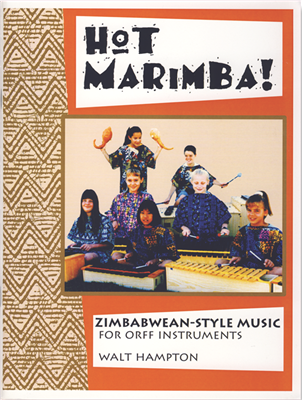
First, I attended the World Music Drumming course, Hot Marimba! Walt Hampton, an elementary marimba music teacher expert, teaches this course. The class is challenging, but for me, it wasn’t just about instructing students on marimbas. The course widened my view of music education and inspired me to continue my professional development.
Most new music educators come out of school being too comfortable with music on the page. Take a moment to reflect on the time spent in your music education degree program. We spend countless hours on our primary instruments practicing for private lessons and participating in classical music ensembles. There’s nothing wrong with this; I loved practicing and playing in the orchestra. I enjoyed performing quality literature and participating in concerts.
However, we don’t spend enough time practicing how to lead or work with an elementary Orff and World Music Drumming ensembles. We don’t spend time learning how to arrange and compose music that fits our elementary schools’ needs. Young teachers are excited to be in their new positions, but many fear venturing into the unknown with these unfamiliar ensembles. Eventually, some will take the steps and learn to lead ensembles like this; unfortunately, for our students, many never will.
$24.95Add to cart
In Hot Marimba! Hampton challenges us to a level of musicianship that made us uncomfortable. Knowing that most of us had never experienced a class like this before, he moved quickly through the parts. We learned everything by ear, so we had to pay close attention, or we missed it.
To be honest, the first day was rough. I thought I knew music. I have a degree in music, and I teach music in a public school, but this was an entirely new way of learning for me.
How do you play by ear when three different marimba parts are playing simultaneously?
Welcome to a whole new world of learning music—a world where we did not spend time tediously counting out rhythms on the page. By the end of the week, it was a world I wanted to be a part of, and opened my eyes to an entirely new approach to teaching.
In addition to teaching the class Hot Marimba! Walt Hampton has published three books utilizing marimba in the elementary and middle school settings. To fully understand the layers within each piece, you need to listen to how the parts connect.
After struggling through the first day, the other participants and I got to know each other, and together we started playing more cohesively. With teamwork, we learned how to play our parts at a high level. When working with my students, I can see precisely how vital collaboration is within these ensembles.
It’s fascinating to see what individual students pick up just by watching and listening. They don’t all learn and hear things the same way, so I love putting them in groups to collaborate on the parts.
Successfully teaching marimbas to students requires being able to play every individual part. I’m not just talking about sight-reading the score on the page but also internalizing the score and understanding how each line of music collaborates with each of the other parts.
Dedicating yourself to this level of understanding is tough! It requires listening to recordings and a lot of practicing. If I work and spend the time learning each part, I can pinpoint exactly where my ensemble is having issues or hear if a specific section lacks confidence. Becoming familiar with teaching marimba has given me the confidence to start writing my songs and arrangements. I view this work as my own personal, professional development.
There’s a great variety of music out there for marimba in the classroom. In the Hot Marimba class, Hampton worked with us on many Zimbabwe inspired pieces out of his three books. These pieces are challenging and are sometimes not always straightforward. The majority of the rhythmic patterns are dotted-eighth, dotted-eighth, eighth, or that same pattern reversed. Only when the teacher and the students feel the rhythms together are the pieces successful.
Doug Edwards also has several books with unique arrangements that appeal to students. His pieces are culturally relevant to our students’, with artists such as Katy Perry, Maroon 5, and many other groups. Both Edwards and Hampton add drum kits to their ensembles, giving them have a more modern feel.
If you haven’t seen either of their groups, you can view Walt’s groups Bahuru and Baduku and Doug Edward’s Marimba Mojo on YouTube.
Marimbas bring a heightened sense of excitement to the classroom, grade-level concerts, and extracurricular groups. Some students love music class, but others struggle for a variety of reasons. When I use marimbas in my classroom, those students who sometimes struggle with behavior are excited to be in class. Students want to play and perform on these instruments.
Marimbas allow students to play loud and cool sounding instruments. They love what they’re doing and want to succeed. They want music more than once a week, and they want to stay after class to play more. For children and adults both, marimba playing is contagious and lively.
My students were going to play marimbas at grade level concerts this year for the first time. As we prepared for the show, the excitement was palpable. Instead of concerts being a routine, the kids were extremely excited to perform for their parents. It gave them an achievable goal to perform their pieces for their loved ones, peers, and teachers. Unfortunately, due to the pandemic, we had to cancel.
Marimbas also provide an excellent platform for extracurricular groups. Marimba bands play all the time in the WA community, whether at farmer markets, hockey games, or college campuses, people love to hear them. Many marimba bands do tours to show off their level of skill and show others that these programs are an attainable goal. Creating an extracurricular group is challenging for the teacher, but it is worth the investment of time.
My intention in this article isn’t to say that marimbas should be in every classroom. Instead, it is to persuade you, as a young music educator, to try something new. Challenge yourself to explore new ways of making music with your students. Keep the passion in your teaching by challenging your musicality and pursuing personal, professional development.
Contributor
Hello, my name is Haviland Gilbert. I currently teach Elementary music in the Kennewick School District in Kennewick, WA. I teach K-5 Music, along with a select 4th and 5th grade marimba ensemble at Lincoln Elementary School, and instruct an after-school orchestra…
Discover more from Haviland Facebook
 Twitter
 Pinterest
 LinkedIn
 Email
Email Print
Print