The challenges of remote music teaching are endless — latency issues, prioritizing one voice over the other participants, and signal drop-outs. Learn techniques to minimize these problems when improvising with students online.
The challenges of remote music teaching are endless — latency issues, prioritizing one voice over the other participants, and signal drop-outs. Additionally, a long list of typical teaching content that is highly problematic online and far more straightforward and satisfying in live settings.
Transforming some online music teaching situations into studio-like environments, students and instructors get around the synchronization issues by recording parts separately, guided by a common track, for later assembly by an engineer. Other skills, notably group improvisation, cannot readily be stripped of simultaneous interactions. Players need to hear each other in real time to coordinate their rhythms, have musical conversations, harmonize, etc. How can improvisation be adapted to online learning in a meaningful way?
Improvisation is both a personal and social activity. When we improvise as preparation for harvesting “keepers,” we use improv to fuel composition — we can do this alone or as a solo activity that can be monitored and showcased online. Similarly, improvising over pre-recorded backing tracks in music-minus-one fashion can be done online with the instructor sharing computer sound. At the same time, we allow one or more students to improvise without interacting with each other. It is a hybrid experience when everyone hears the same common track as the stimulus to improvise with, but there is no opportunity for collaboration or coordination.
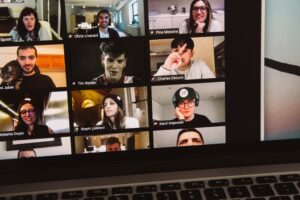
In contrast, the social aspects of improvisation are a challenge to realize in the online setting. From video phone apps to video conference apps, the most common formats are all designed for spoken voice, one speaker at a time. The built-in algorithms in platforms such as Zoom and Skype do not permit the controlled mixing of separate input sources, which makes balancing the levels of multiple players unpredictable. The variations in the way internet signals travel create delays so that not all participants hear the same sounds simultaneously. These delays profoundly impact rhythmic coordination.
Remote Group Improv Strategies
What helps address these limitations? For one, leave a good deal of space in the sound. Space can mean playing slowly or playing sparsely. Players can have musical improvised conversations in which they take turns, waiting until each one finishes before offering their reaction or response.
Players canattempt long-tone harmonization, although there will be times when one person’s signal or the other will dominate, no matter how well we optimize the app settings for music (noise reduction limited and original sound turned on).
Reduce group size by using breakout groups. A class of 24 students can interact as eight separate trios, with the composition of each one chosen randomly or assigned by the instructor. This function can be implemented with set time limits, after which the group is brought back together in one virtual room.
Players can participate in improvisations inspired by pieces of art or writing that are screen-shared by the instructor, allowing for multiple interpretations in musical form.
In a recent online improvisation class, our group had one vision-impaired student. She participated and improvised along with the screen-shared art and writing by using the breakout group feature. The host created a temporary breakout group for the two of them and verbalized the material that the other participants could see for themselves.
Similarly, we recently used the Music Doctor Improv Cards in an online group. Breakout groups were predetermined, and utilizing the chat private message function, we assigned each person in the breakout a different role to fulfill during the improvisation.
One such card was “solo or else be silent,” another was “bring the blues,” and a third was “provide a steady drone tone.” The goal was not to rigidly fulfill this role the whole time but to include the suggestion as part of the player’s inspiration to contribute. Afterward, there was an opportunity to guess each player’s role and to discuss the growing edges involved in steering an improvisation in these kinds of directions.
James Oshinsky, Ph.D. is a psychologist and musician. He teaches improvisation at Adelphi University. Jim is the author of Return to Child, a book detailing the improvisation pedagogy of the late cellist David Darling and the organization, Music for…





 Facebook
 Twitter
 Pinterest
 LinkedIn
 Email
Email Print
Print
