In Part 1 of this series, we discussed the many benefits of bringing ukuleles into the classroom. In part two we go over the four sizes of ukuleles available and which might be best for your students.
by Sam Marchuk
This blog originally appeared on westmusic.com on Oct 10, 2017 and is posted with the permission of West Music.
Featured Products
Which Ukulele Model Should I Choose? (Part 3: Starting a Ukulele Program in Your Classroom)
There are many different models of ukuleles available, so how do you which one you should choose for your classroom? Music educator Sam Marchuk will show you some options.
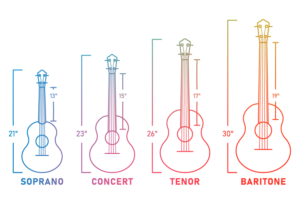
The first thing to know is that there are 4 different sizes of ukuleles to choose from soprano, concert, tenor, and baritone. The smallest of these, the soprano, is the most common for beginners. This is due to it having the lowest cost of the bunch, making it the best value when purchasing a classroom set. It is also considered the “standard” ukulele size, dating back from its original roots in Hawaii in the late 1870s.
Children and adults alike can enjoy soprano size ukulele and will be pleased with the bright, signature sound, portability, and cost. But what about the larger concert or tenor sizes, which feature the same tuning? If your budget allows, there can be several advantages if you decide to use a larger size ukulele in your classroom.
Advantages of Using a Larger Size Ukulele
Fuller, Deeper Sound
larger resonator body allows the lower tones to resonate, providing a fuller, deeper sound. This creates a more well-balanced and pleasing tone over the soprano model.
Comfort
The larger body and longer neck may be more comfortable to hold, which may put the instrument in a more natural playing position for some students.
Less Cramped
More frets and space between them. This will allow for easier finger positions when moving up the fretboard as fingers will become less cramped.
More Range
This may be more useful if you are offering advanced classes where you will play beyond the first position (past the first 5 frets). Concert and tenor ukuleles typically have a higher range with 17 or more frets to a soprano’s 12. The extra frets may come in handy and add more interest when playing with a ukulele ensemble.
Students’ Perception
Students may view it as more as a true musical instrument and less as a novelty/toy. The larger ukulele size becomes more guitar-like to play and listen to.
Concert or Tenor?
Only a bit larger than a soprano, concert size ukulele may be the ideal choice for many of these reasons. For this reason, the concert size is often referred to the in-between, or “Goldilocks” size for its perfect blend of characteristics of the soprano and tenor.
A tenor ukulele is also an option, with it having the fullest sound due to an even larger body than the concert size. But it can become considerably more expensive than the soprano, especially when purchased in sets and feel too large to comfortably hold for younger students.
What About Baritone?
The baritone ukulele tuned differently to a fourth lower than the other ukulele sizes, which are the same pitches as the top four guitar strings. Therefore, the baritone is in a different key and requires different fingering from the soprano/concert/tenor. See this article for more information on ukulele tunings and size comparisons: Models and Tunings and Sizes, Oh My! How to Choose the Right Ukulele for You.
Other Considerations
For demonstrative and personal use, teachers may want to opt for a larger or different model ukulele to make their instrument stand out from the student models. That may be another example where concert or tenor may be a good choice for them, even if their students use the soprano.
Summary
Ultimately, the deciding factors on the sizes of ukuleles are going to come to the budget you are working with, and the use of ukulele as an introduction or advanced lessons. Contact one of West Music’s Education Consultants at 800-397-9378 to see how they can put together a set of classroom ukuleles to best suit your budget and needs!
Sam Marchuk served for 7 years as an Education Consultant for West Music specializing in folk instruments and curriculum for the elementary classroom. He has been playing ukulele since 2005 and is an avid collector of vintage and contemporary…






 Facebook
 Twitter
 Pinterest
 LinkedIn
 Email
Email Print
Print